Deep lines from your nose to your mouth that make you look tired, even when you are not? Why smile lines (法令纹, nasolabial folds) deepen, why filling them flat is rarely the answer, and which treatments soften them naturally.
Medically reviewed by Dr. Adriene Chee, Medical Director, Verve Clinic. Last updated: 20 November 2026.
You catch your reflection and the lines between your nose and mouth look deeper than you remember. Friends ask if you are tired. Concealer settles into the creases by lunchtime. It is one of the most common concerns we hear at the clinic, from people in their thirties onwards.
The good news is that smile lines can be softened without surgery. The key is understanding what is actually making them deeper, because the answer is often not the line itself. In this guide, Dr. Adriene Chee, a doctor with more than 10 years of experience, explains the causes and the treatments that work for each.
What are smile lines?
In short: Smile lines (法令纹), also called nasolabial folds or laugh lines, run from the sides of the nose to the corners of the mouth. They deepen with age as the cheeks lose volume and sag and the base of the nose becomes hollow. Treatment works best when it targets the cause, often by lifting the cheek, rather than filling the fold flat.
Everyone has these lines when they smile, and a little definition here is part of a natural, expressive face. They become a concern when the fold stays deep at rest, casts a shadow, or makes the lower face look heavy or tired.
What causes smile lines to deepen?
The fold sits where the cheek meets the area around the mouth. Research on facial anatomy, including a widely cited study in Plastic and Reconstructive Surgery, shows that the fat of the face sits in separate compartments, one of them directly beside the smile line, and that these compartments change at different rates as we age. This is why the fold usually has more than one cause:
- Cheek volume loss: the cheeks (苹果肌) flatten and lose support, so the tissue above the fold no longer holds up.
- Sagging: skin and the tissue underneath loosen and slide downwards, piling up against the fold.
- Heavier fat beside the fold: the fat pad next to the smile line tends to become more prominent with age, which makes the fold look deeper.
- Hollowness at the base of the nose (鼻基底): when the area beside the nostrils becomes hollow, the upper part of the fold looks deeper and the face can look older.
- Thinner, less elastic skin: with less collagen, the skin creases more easily and stays creased.
Genetics, face shape, sun exposure, weight changes and smoking also play a part. At your consultation, we look at your face at rest and when smiling, from the front and the side, to see which causes matter most for you.
Why filling smile lines flat is rarely the answer
It is tempting to fill the line itself until it disappears. But if the real cause is a sagging or flat cheek, filling the fold alone adds weight to the lower face. The line may soften for a while, but the face can start to look heavy, wide or unnatural, especially after repeated top-ups. We explain more in our article on overfilled face syndrome.
Instead, we aim to soften the fold by treating the cause: supporting the cheek or the base of the nose, lifting sagging tissue, and improving the skin. Often only a small amount of filler, or none at all, is needed in the fold itself.
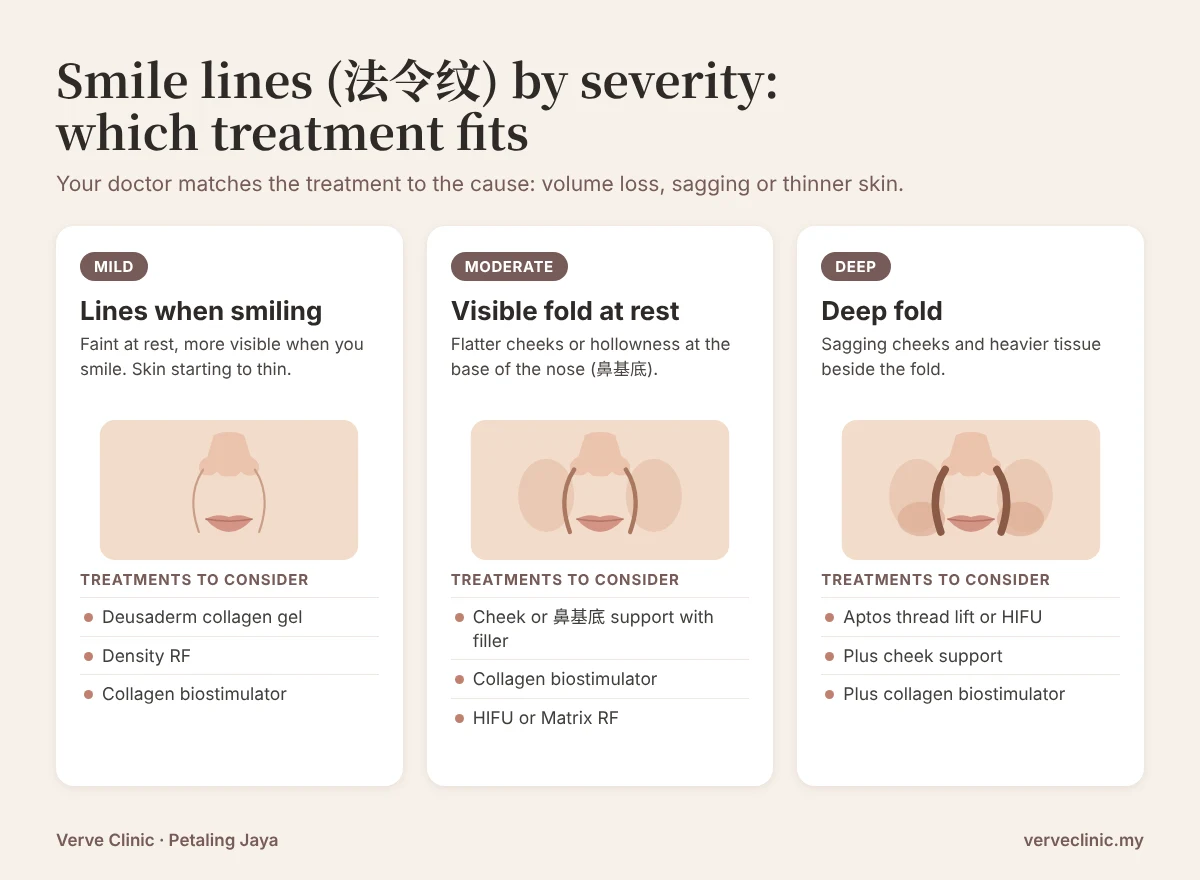
Smile lines by severity: which treatment fits
| Severity | What it looks like | Treatments to consider |
|---|---|---|
| Mild | Lines mainly when smiling, faint at rest, skin starting to thin | Deusaderm collagen gel, Density RF, a collagen biostimulator |
| Moderate | A visible fold at rest, with some flattening of the cheek or hollowness at 鼻基底 | Cheek or 鼻基底 support with filler, a collagen biostimulator, HIFU or Matrix RF microneedling |
| Deep | A deep fold with sagging cheeks and heavier tissue beside the fold | Aptos thread lift or HIFU to lift, combined with cheek support and a collagen biostimulator |
How are smile lines treated?
Each treatment works on a different cause. Most people get the most natural result from a combination, planned around their face.
HA filler for the fold and the cheek
Hyaluronic acid (HA) filler restores lost volume. Placed in the cheek or at the base of the nose, it supports the tissue above the fold, so the line softens from above. A small amount can also be placed in the fold itself. Results are visible straight away. Filler in the fold typically lasts 6 to 12 months, and cheek filler usually lasts longer. There may be mild swelling or bruising for a few days, and HA filler can be dissolved if needed. Learn more about filler for smile lines or our dermal fillers for the cheeks.
Collagen biostimulator
A collagen biostimulator prompts the skin to build new collagen and restores some lost volume, so the cheeks look firmer and gently lifted over 2 to 3 months. It is usually done in 2 to 3 sessions, 4 to 6 weeks apart, with mild swelling or bruising for 1 to 3 days. Results typically last 18 to 24 months.
Aptos thread lift
An Aptos thread lift uses fine dissolvable threads to lift sagging cheeks straight away, which takes weight off the fold. As the threads dissolve, they stimulate collagen, so the skin keeps firming over 1 to 6 months. Results typically last 18 to 24 months. Expect mild swelling or tightness for 3 to 7 days.
HIFU
HIFU uses focused ultrasound to tighten the deep supporting layer of the face, lifting the cheeks and lower face without needles. It is usually done as a course of 3 sessions, with results lasting about a year. HIFU is not ideal for very thin faces, because it can make them look more hollow.
Density RF and Matrix RF microneedling
Density RF tightens the full face in usually one session, with no downtime and maintenance every 6 to 12 months. Matrix RF microneedling delivers RF energy inside the skin to tighten and lift, usually in 3 sessions 4 to 6 weeks apart, with 1 to 2 days of pinkness. Both suit people who want firmer skin without adding volume.
Deusaderm collagen gel
Deusaderm collagen gel adds collagen directly to the skin, which softens fine lines straight away and then supports your own collagen over the following months. It is usually done in 2 to 3 sessions, 4 weeks apart, with results lasting 9 to 12 months. It suits thinner skin and fine lines around the fold.
Our skin tightening and lifting guide compares HIFU, RF microneedling, Density RF and collagen biostimulators in more detail.
Smile line treatments compared
| Treatment | Main effect | Sessions | Downtime | Results last |
|---|---|---|---|---|
| HA filler (fold or cheek) | Restores volume, supports the fold | Usually 1 | A few days of mild swelling | 6 to 12 months in the fold, longer in the cheek |
| Collagen biostimulator | Builds collagen, restores some volume | 2 to 3 | 1 to 3 days | 18 to 24 months |
| Aptos thread lift | Lifts sagging cheeks | Usually 1 | 3 to 7 days | 18 to 24 months |
| HIFU | Tightens the deep layer | 3 | Mild tenderness | About a year |
| Density RF | Tightens the full face | Usually 1 | None | 6 to 12 months |
| Matrix RF microneedling | Tightens from inside the skin | 3 | 1 to 2 days of pinkness | About 12 months |
| Deusaderm collagen gel | Softens fine lines, firms skin | 2 to 3 | 1 to 2 days | 9 to 12 months |
Combination treatment for smile lines
Because the fold rarely has only one cause, combining treatments usually gives a softer, more natural result than relying on filler alone. Combinations suit both younger patients with early lines and older patients with deeper folds; the plan simply changes with the cause.
- HA filler + a collagen biostimulator: filler softens the fold and supports the cheek or 鼻基底 straight away, while the biostimulator builds collagen for longer-lasting firmness.
- HIFU or Density RF + a collagen biostimulator: lifts and tightens while building collagen, for early sagging.
- Aptos thread lift + cheek support: lifts sagging cheeks and restores volume for deeper folds.
- Deusaderm collagen gel or Matrix RF microneedling: improves thin, creased skin along the fold.
What to expect
- Consultation: your doctor looks at your face at rest and when smiling, from several angles, to find the main causes of your folds.
- Your plan: we recommend the treatment or combination that fits the cause, and explain the number of sessions and expected downtime.
- Treatment: numbing cream or local anaesthetic is used where needed, so most people feel only mild discomfort.
- Results: filler and thread lifts show results straight away, while collagen-building and energy-based treatments improve gradually over weeks to months.
- Maintenance: because ageing continues, most people benefit from a top-up or maintenance treatment every 6 to 24 months, depending on the treatment.
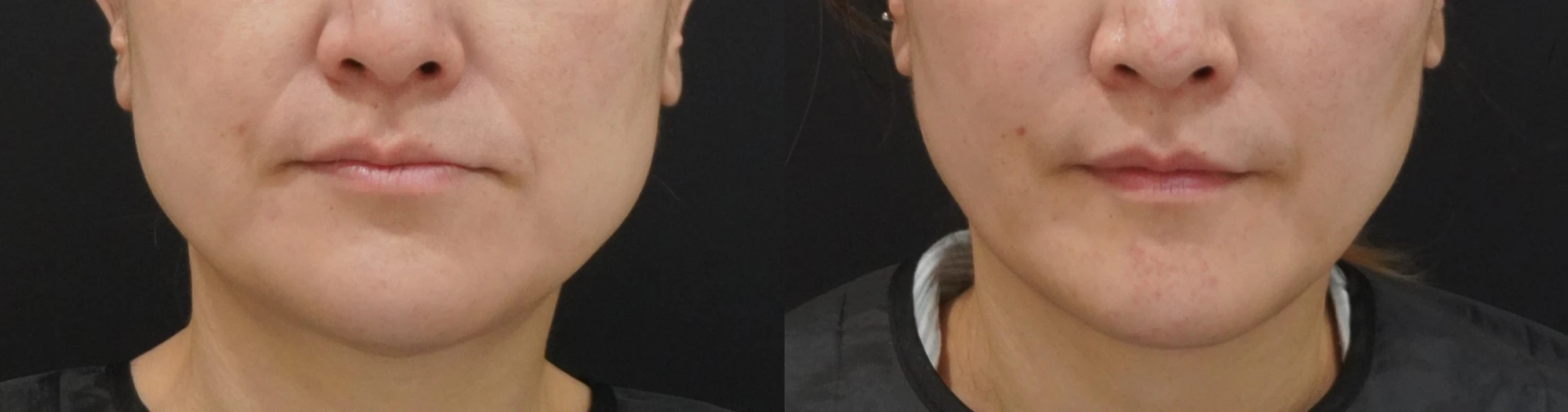
Smile lines before and after
Can smile lines be removed completely?
A note from Dr. Adriene Chee: “We do not chase a completely flat smile line. A natural face has some definition there, especially when you smile. Instead, we find out what is causing the fold to deepen and treat that cause. Lifting treatments often improve smile lines more naturally than filling the line flat.”
| Smile lines treatment quick facts | |
|---|---|
| Main causes | Cheek volume loss, sagging, heavier fat beside the fold, hollowness at 鼻基底, thinner skin |
| Treatments | HA filler, collagen biostimulator, Aptos thread lift, HIFU, Density RF, Matrix RF microneedling, Deusaderm collagen gel |
| Downtime | None to 7 days, depending on the treatment |
| Results last | About 6 to 24 months, depending on the treatment |
| Our approach | Treat the cause and lift where needed, rather than filling the fold flat |
How much does smile line treatment cost in Malaysia?
The cost depends on what is causing your folds, the treatments you need and the number of sessions. That is why we give a personalised quote after your consultation, rather than a fixed package.
Frequently asked questions
What are smile lines?
Smile lines (法令纹), also called nasolabial folds or laugh lines, are the lines that run from the sides of the nose to the corners of the mouth. Everyone has them when smiling. They become a concern when they stay deep and visible at rest, which usually happens with age.
What causes smile lines?
They deepen mainly because of ageing: the cheeks lose volume and sag, the skin loses collagen and firmness, the fat beside the fold becomes heavier, and the area at the base of the nose (鼻基底) can become hollow. Genetics, sun exposure, weight changes and smoking can make them appear earlier.
Can smile lines be removed completely?
A natural face always has some smile lines, especially when smiling. The aim of treatment is to soften folds that look deep at rest, not to make the area completely flat, which can look unnatural.
What is the best treatment for smile lines?
There is no single best treatment, because smile lines have different causes. If the fold is caused by cheek volume loss, cheek filler or a collagen biostimulator helps. If it is caused by sagging, lifting with HIFU, RF or a thread lift works better. Many people benefit from a combination, planned after a doctor’s assessment.
Is filler good for smile lines?
Filler can soften smile lines straight away, and supporting the cheek or the base of the nose (鼻基底) often works better than filling the fold alone. Putting too much filler directly into the fold can make the lower face look heavy, so we use it carefully and often combine it with lifting treatments.
How long does filler for smile lines last?
Filler placed in the fold typically lasts 6 to 12 months, depending on the product. Cheek filler usually lasts longer than filler in the fold.
Can HIFU or RF improve smile lines?
Yes, when sagging is part of the cause. HIFU and RF treatments such as Density RF and Matrix RF microneedling tighten and lift the skin and the tissue underneath, which can soften the fold without adding volume. They are not ideal for very thin faces.
Does a thread lift help smile lines?
Yes. An Aptos thread lift lifts sagging cheeks straight away, which can reduce the weight sitting on the smile line. Results typically last 18 to 24 months.
How can I reduce smile lines without filler?
Smile lines can often be softened without filler, especially when sagging or thinner skin is the main cause. HIFU, Density RF and Matrix RF microneedling tighten and lift, an Aptos thread lift lifts sagging cheeks, and a collagen biostimulator or Deusaderm collagen gel builds collagen. A doctor can tell you which suits the cause of your folds.
Do smile lines come back after treatment?
Results are long-lasting but not permanent, because the face keeps ageing. Filler in the fold typically lasts 6 to 12 months, while collagen-building treatments and thread lifts can last 18 to 24 months. Maintenance treatment keeps the improvement.
Is there downtime?
It depends on the treatment. Density RF has no downtime. Filler, a collagen biostimulator and Deusaderm collagen gel usually cause mild swelling or bruising for 1 to 3 days. A thread lift may cause swelling or tightness for 3 to 7 days.
At what age do smile lines appear?
These lines can be visible at any age when smiling. They usually start to stay visible at rest from the thirties onwards, although genetics, face shape and lifestyle make a big difference.
Can smile lines be prevented?
They cannot be fully prevented, because ageing continues, but daily sun protection, not smoking, a stable weight and early collagen-building treatment can help slow them down.
What are 法令纹 and garis senyuman?
法令纹 is the Chinese term for smile lines or nasolabial folds. Garis senyuman is the Malay term. 鼻基底 refers to the area at the base of the nose, beside the nostrils, where hollowness can make the upper part of the fold look deeper.
How much does smile line treatment cost in Malaysia?
It depends on the cause of your smile lines, the treatments you need and the number of sessions. WhatsApp us for a personalised quote after your consultation.
Ready to soften your smile lines naturally?
If you are looking for smile line treatment in Petaling Jaya, Verve Clinic welcomes patients from Kuala Lumpur, PJ and across the Klang Valley. A doctor will assess what is causing your folds and plan a treatment that softens them while keeping your face natural. WhatsApp us to arrange your consultation and a personalised quote.
About the author
Dr. Adriene Chee is the Medical Director of Verve Clinic in Petaling Jaya. She has more than 10 years of experience. Her qualifications include an MD from the National University of Malaysia (UKM), a Postgraduate Diploma in Dermatology (Bangkok) and an LCP in Aesthetic Medicine. Meet our team.
This article is general information, not medical advice. Results vary from person to person. Please discuss the benefits and risks of any treatment with a qualified doctor.