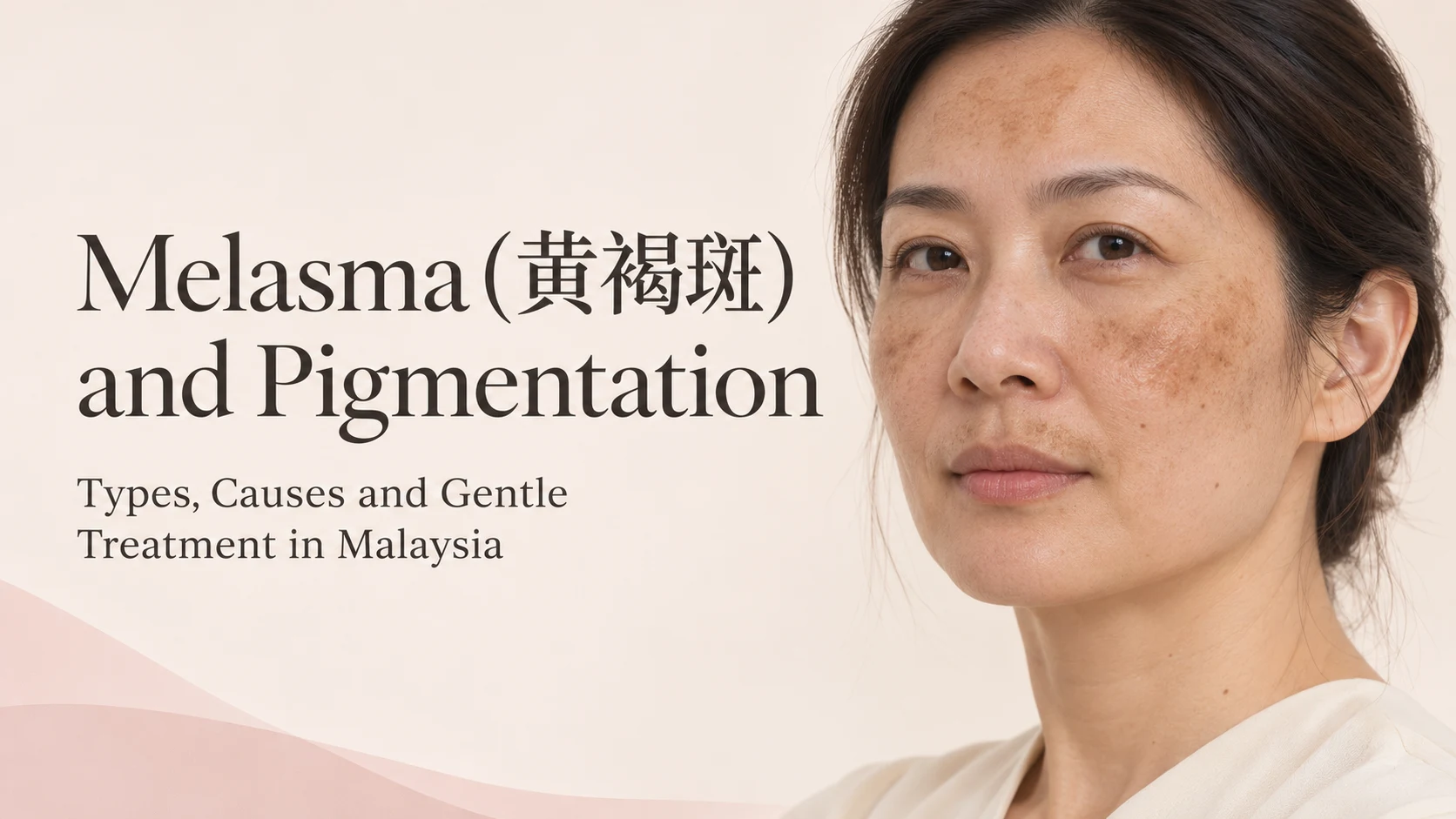
Brown patches on your cheeks that keep coming back? What melasma (黄褐斑) is, how it differs from freckles, sun spots and other pigmentation (色斑, jeragat), and how gentle treatment and sun protection keep it under control.
Medically reviewed by Dr. Adriene Chee, Medical Director, Verve Clinic. Last updated: 18 November 2026.
The patches on your cheeks seem darker every year. Foundation covers them for a few hours, then they show through again. You have tried brightening creams, and maybe even a laser, only for the marks to come back, sometimes darker than before.
If this sounds familiar, you may have melasma, one of the most common skin concerns we see in Malaysia. In this guide, Dr. Adriene Chee, a doctor with more than 10 years of experience, explains what melasma is, how to tell it apart from other pigmentation, and how we treat it gently so it stays under control.
What is melasma?
In short: Melasma (黄褐斑) causes blotchy brown or grey-brown patches, usually on both cheeks, the forehead or the upper lip. It is triggered by sun, heat and hormones, and is common in Asian skin. It usually cannot be cured permanently, but gentle laser, skin boosters, peels and daily sun protection can control it very well.
It happens when the pigment cells in the skin become overactive and produce too much melanin in certain areas. The patches usually appear on both sides of the face in a fairly even pattern, and they often darken after sun exposure or hormonal changes.
Melasma is especially common in Asia. A 2023 review in Clinical, Cosmetic and Investigational Dermatology reported that melasma affects up to 40% of people in Southeast Asian populations, and noted that it often comes back after treatment. It is more common in women, usually from the twenties onwards, but men can have it too.
What causes melasma?
- Sun and heat: ultraviolet and visible light, and even heat, stimulate the pigment cells. This is why the patches often darken in sunny climates like Malaysia.
- Hormones: pregnancy and the contraceptive pill can trigger or worsen it. Thyroid problems are also linked.
- Genetics: it often runs in families and is more common in Asian and darker skin types.
- Skin irritation: harsh products, aggressive treatments and strong lasers can inflame the skin and make pigmentation worse.
At your consultation, we check for these triggers, including pregnancy, the contraceptive pill and thyroid problems, because controlling the trigger is part of controlling the patches.
Why pigmentation is so common in Malaysia
Malaysia has strong sun all year round, along with heat and humidity. Asian skin produces melanin readily. This protects the skin, but it also means marks darken easily and fade slowly. Daily habits add up too: the drive to work, a walk at lunchtime, or sitting near a sunny window all expose the skin to light, even on cloudy days.
Common habits that make pigmentation worse
- Skipping sunscreen on cloudy days, indoors near windows or while driving.
- Using harsh scrubs or strong brightening products without a doctor’s advice.
- Picking at spots, acne or scabs, which leaves new dark marks.
- Having strong laser sessions too close together.
- Stopping maintenance and sun protection once the patches have faded.
Small changes to these habits often make treatment work better and help results last longer.
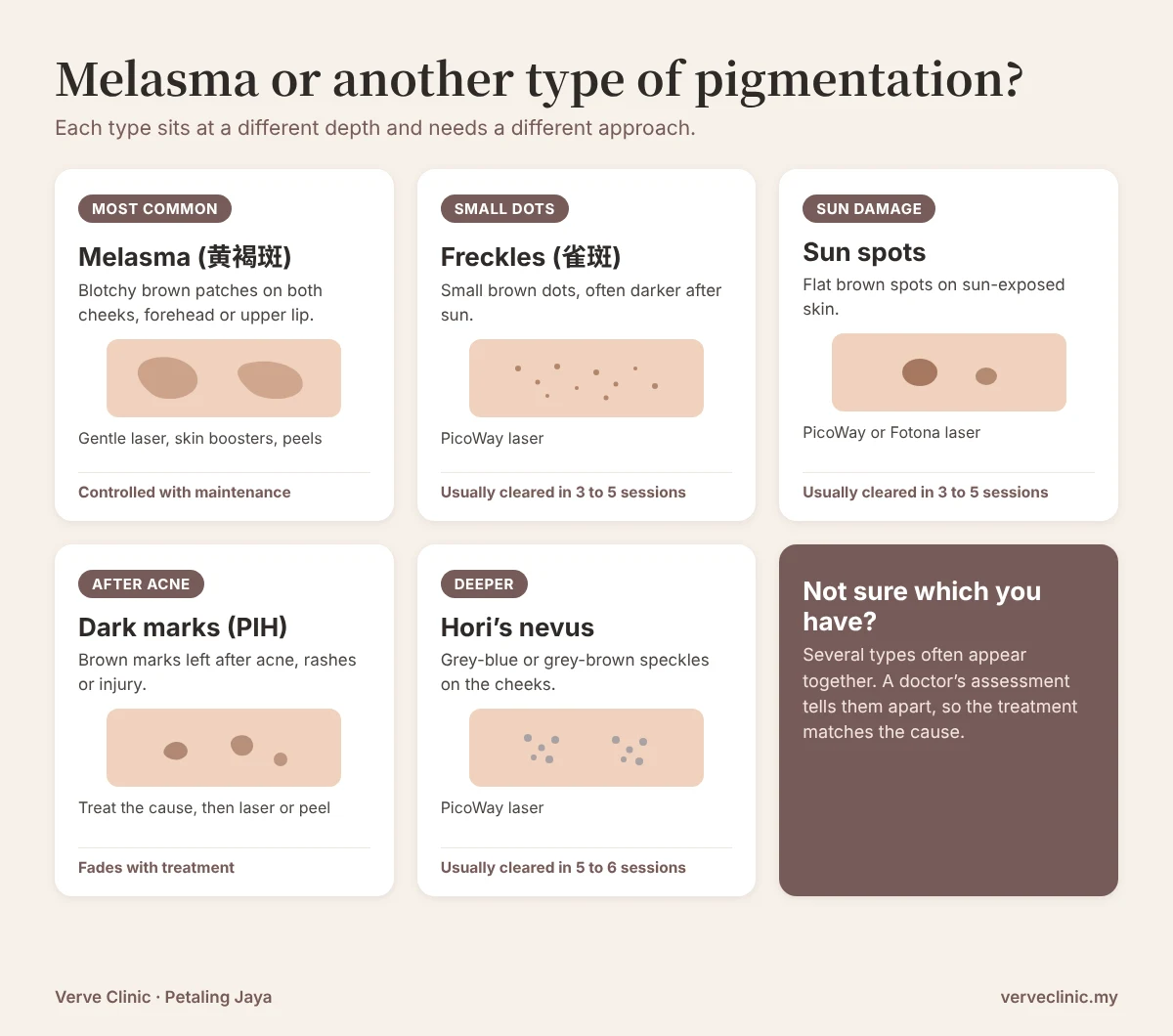
Melasma or another type of pigmentation (色斑)?
Not every brown mark is melasma. Each type of pigmentation sits at a different depth in the skin and needs a different approach, and several types often appear together.
| Type | What it looks like | Usual treatment | What to expect |
|---|---|---|---|
| Melasma (黄褐斑) | Blotchy brown patches on both cheeks, forehead or upper lip | Gentle laser, skin boosters, collagen gel, chemical peel | Controlled with treatment and maintenance |
| Freckles (雀斑) | Small brown dots that darken in the sun | PicoWay laser | Usually cleared in 3 to 5 sessions |
| Sun spots | Flat brown spots on sun-exposed skin | PicoWay or Fotona laser | Usually cleared in 3 to 5 sessions |
| Dark marks after acne (PIH) | Brown marks after acne, rashes or injury | Treat the cause first, then laser or peel | Fade with treatment |
| Hori’s nevus | Grey-blue or grey-brown speckles on the cheeks | PicoWay laser | Usually cleared in 5 to 6 sessions |
If your dark marks come from acne, treating the acne itself comes first. Our acne treatment guide explains how.
How is melasma treated?
These patches respond best to a gentle, step-by-step approach. We usually prepare the skin first, then combine low-energy laser with treatments that strengthen and calm the skin, rather than relying on one strong treatment.
PicoWay laser
The PicoWay laser delivers ultra-short pulses that break pigment into tiny particles, which the body then clears. Used at gentle settings, it lightens patches with little heat, and it is also our main treatment for freckles, sun spots and Hori’s nevus. Read more about PicoWay.
Fotona laser toning
Gentle Fotona laser toning evens out skin tone and gradually reduces pigmentation, with minimal downtime. It is often combined with PicoWay or skin boosters.
Skin boosters and collagen gel
Skin boosters and a collagen gel strengthen and repair the skin, improve hydration and help lighten pigmentation. Healthier, calmer skin is less prone to flare-ups, which is why we often use them to prepare the skin before laser and alongside it. Compare the skin boosters we use.
Chemical peel
A chemical peel gently removes the top layer of dull, pigmented skin and helps other treatments work better. We choose a mild peel suited to sensitive, pigment-prone skin.
Melasma treatments compared
| Treatment | What it does | Downtime |
|---|---|---|
| PicoWay laser | Breaks up pigment gently; also clears freckles and sun spots | Minimal to none |
| Fotona laser toning | Evens skin tone and reduces pigmentation | Minimal to none |
| Skin boosters | Repairs and hydrates skin, helps lighten pigmentation | Minimal |
| Collagen gel | Strengthens the skin and supports pigmentation treatment | Minimal |
| Chemical peel | Removes dull, pigmented surface skin | Minimal to none, with possible light flaking |
Can laser make melasma worse?
Skin prone to these patches is easily irritated. A laser used at high energy, or too often, can inflame the skin and trigger rebound pigmentation, where the patches come back darker than before. This is a common reason people tell us laser “did not work” or made things worse.
To avoid this, we prepare the skin with other treatments first, rather than starting with laser itself. When laser is added, we use gentle, low-energy settings and combine it with skin boosters, a collagen gel or peels, so each treatment can be gentler. The aim is steady improvement without irritating the skin.
What to expect during melasma treatment
- Consultation: your doctor examines your pigmentation, identifies the type and checks for triggers such as pregnancy, the contraceptive pill or thyroid problems.
- Skin preparation: the skin is strengthened and calmed first, so it tolerates laser better.
- Treatment course: usually 3 to 5 sessions, about 1 month apart, with minimal or no downtime.
- Results: most people see lighter patches after 1 to 2 sessions.
- Maintenance: every 3 to 6 months, depending on your lifestyle and sun exposure.
Why sun protection is essential for melasma
Sunlight, including visible light and heat, is one of the strongest triggers. Even after successful treatment, patches can darken again within weeks without sun protection. Daily sunscreen, reapplied when you are outdoors, plus shade, a hat or an umbrella in the midday sun, is part of every treatment plan, not an optional extra.
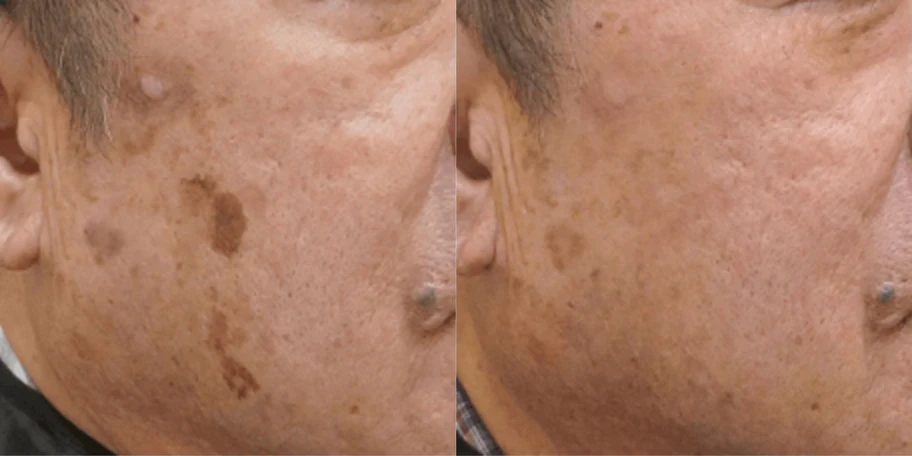
Pigmentation before and after
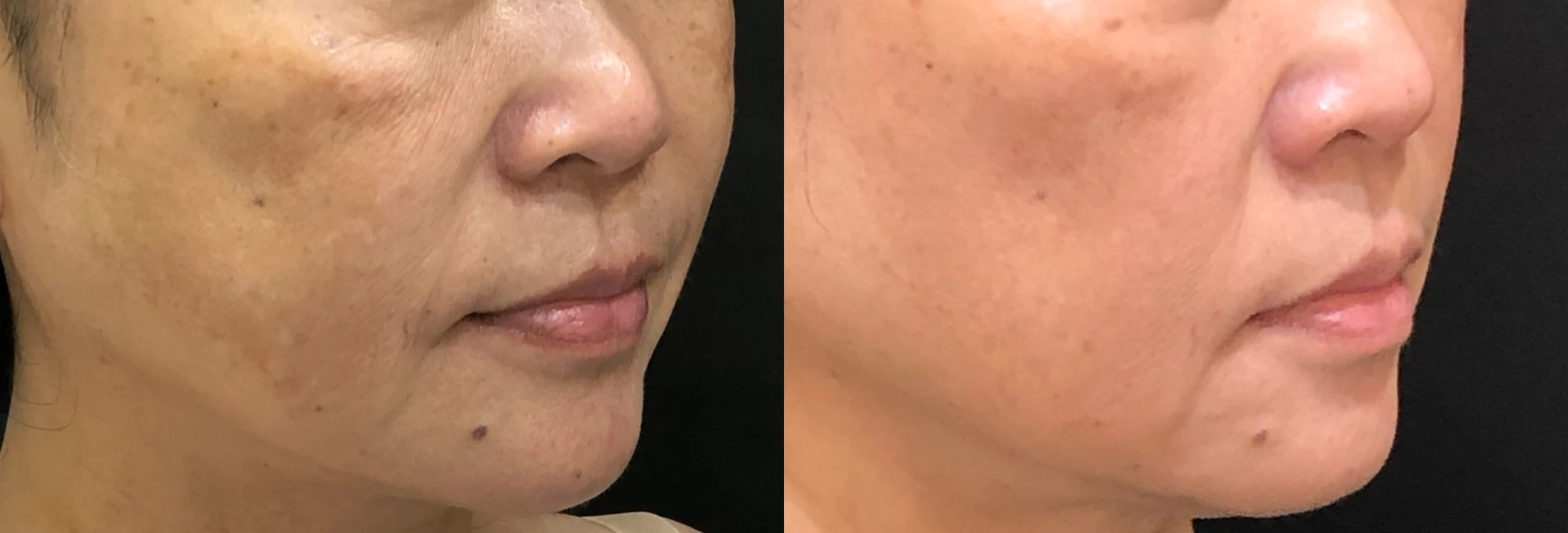
Can melasma be cured? What results to expect
A note from Dr. Adriene Chee: “Melasma can be controlled very well, but it needs patience, gentle treatment and daily sun protection. Harsh lasers often make it worse. I explain to every patient that it is not cured once and for all, because the triggers are still there. With the right combination and regular maintenance, most people see their patches fade significantly and stay much lighter.”
| Treatment quick facts | |
|---|---|
| Sessions | Usually 3 to 5, about 1 month apart |
| Downtime | Minimal or none |
| Results visible | After 1 to 2 sessions |
| Maintenance | Every 3 to 6 months, depending on lifestyle |
| Other pigmentation | Freckles and sun spots usually clear in 3 to 5 sessions; Hori’s nevus in 5 to 6 |
How much does melasma treatment cost in Malaysia?
The cost depends on the type of pigmentation, the treatments you need and how many sessions. That is why we give a personalised quote after your consultation, rather than a fixed package.
Frequently asked questions
What is melasma?
Melasma (黄褐斑) is a common skin condition that causes blotchy brown or grey-brown patches, usually on both cheeks, the forehead, the nose or the upper lip. It is linked to sun exposure, hormones and genetics, and is especially common in Asian skin.
Can melasma be cured permanently?
Melasma usually cannot be cured permanently, because the triggers, such as sun, heat and hormones, are still there. It can be controlled very well with the right treatment, sun protection and regular maintenance.
What is the best treatment for melasma?
There is no single best treatment. It usually responds best to a combination of gentle, low-energy laser such as PicoWay or Fotona, skin boosters or a collagen gel to strengthen the skin, chemical peels and strict daily sun protection, planned after a doctor’s assessment.
Is pico laser good for melasma?
Pico laser such as PicoWay, used at gentle, low-energy settings, can help lighten melasma, especially as part of a combination with skin boosters, a collagen gel or peels. It is also our main treatment for freckles, sun spots and Hori’s nevus. Strong settings can irritate the skin, so the settings matter as much as the laser itself.
Can laser make melasma worse?
Yes, if the laser is too strong. Aggressive laser treatment can irritate the skin and trigger darker patches, called rebound pigmentation. This is why we prepare the skin first and use gentle, low-energy settings, often combined with other treatments.
How many sessions do I need for melasma?
Most people need 3 to 5 sessions, about 1 month apart, followed by maintenance every 3 to 6 months depending on lifestyle and sun exposure.
When will I see results?
Most people notice lighter patches after 1 to 2 sessions, with further improvement over the course of treatment.
Is there downtime?
Downtime is minimal or none. Most people return to work or daily activities straight away.
What is the difference between melasma and freckles?
Melasma appears as larger, blotchy patches on both sides of the face and is linked to hormones and sun. Freckles (雀斑) are small, scattered brown dots that darken in the sun. Freckles can usually be cleared with laser, while melasma needs ongoing control.
Can freckles, sun spots and Hori’s nevus be removed?
Yes. Freckles and sun spots can usually be cleared with laser in 3 to 5 sessions. Hori’s nevus sits deeper in the skin and usually needs 5 to 6 sessions. New spots can still appear with sun exposure.
Does pregnancy or the contraceptive pill cause melasma?
They can trigger or worsen it, because hormones play a part. Thyroid problems are also linked. We check for these triggers at your consultation.
Why is sunscreen so important for melasma?
Sunlight, including visible light and heat, is one of the strongest triggers. Without daily sun protection, patches darken again quickly, even after successful treatment.
Can men get melasma?
Yes. Melasma is more common in women, but men can get it too, and the same treatments are used.
How do I get rid of jeragat?
Jeragat (freckles and dark spots) can usually be lightened or cleared with laser such as PicoWay, typically in 3 to 5 sessions, together with daily sun protection. A doctor should first check whether the spots are freckles, sun spots, melasma or Hori’s nevus, because each is treated differently.
What are jeragat, 色斑, 黄褐斑 and 祛斑?
Jeragat is the Malay term for freckles and dark spots on the face. 色斑 is the Chinese term for pigmentation spots, 黄褐斑 means melasma and 祛斑 means removing pigmentation.
How much does melasma treatment cost in Malaysia?
It depends on the type of pigmentation, the treatments you need and how many sessions. WhatsApp us for a personalised quote after your consultation.
Ready to get your pigmentation under control?
If you are looking for melasma or pigmentation treatment in Petaling Jaya, Verve Clinic welcomes patients from Kuala Lumpur, PJ and across the Klang Valley. A doctor will identify your type of pigmentation, check for triggers and plan a gentle treatment course that suits your skin. WhatsApp us to arrange your consultation and a personalised quote.
About the author
Dr. Adriene Chee is the Medical Director of Verve Clinic in Petaling Jaya. She has more than 10 years of experience. Her qualifications include an MD from the National University of Malaysia (UKM), a Postgraduate Diploma in Dermatology (Bangkok) and an LCP in Aesthetic Medicine. Meet our team.
This article is general information, not medical advice. Results vary from person to person. Please discuss the benefits and risks of any treatment with a qualified doctor.