Why horizontal neck lines (颈纹) appear, how to tell how deep yours are, and which treatments smooth them, from skin boosters and Matrix RF microneedling to HIFU, Density RF and collagen biostimulators.
Medically reviewed by Dr. Adriene Chee, Medical Director, Verve Clinic. Last updated: 18 November 2026.
You take good care of your face. Then you catch your reflection at an angle, or see yourself in a photo, and notice the lines across your neck. Makeup settles into them, a high collar only hides them for so long, and they can make you look older than your face does.
Neck lines are one of the most common concerns we see in patients from their thirties onwards, and one of the most overlooked. In this guide, Dr. Adriene Chee, a doctor with more than 10 years of experience, explains why neck lines form, how to judge how deep yours are, and which treatments can smooth them.
What are neck lines?
In short: Neck lines (颈纹) are horizontal creases across the front of the neck, sometimes called necklace lines. They form because neck skin is thin and loses collagen with age, and because the neck bends all day. They can be softened with skin boosters, RF microneedling, collagen biostimulators, filler, HIFU or Density RF, depending on how deep they are.
Neck lines, also called neck wrinkles or necklace lines, usually run in one to three rings across the front of the neck. Early on they are faint and crepey. Over time they become deeper and stay visible even when you look straight ahead, and the skin around them can become looser.
Why do neck lines form?
Several things work together to cause neck lines:
- Thin skin: the skin on the neck is thinner than on the face, with fewer oil glands, so it shows lines earlier.
- Collagen loss: from our mid-twenties, the skin makes less collagen and elastin, so it becomes less firm and springy.
- Movement: the neck bends and turns thousands of times a day. Looking down at a phone or laptop for long periods, sometimes called tech neck, deepens the creases.
- Sun exposure: the neck is often missed when applying sunscreen, so UV light breaks down its collagen faster.
- Genetics and weight changes: some people have neck lines from a young age because of how their skin and fat sit, and weight changes can stretch the skin.
How deep are your neck lines? Treatment by severity
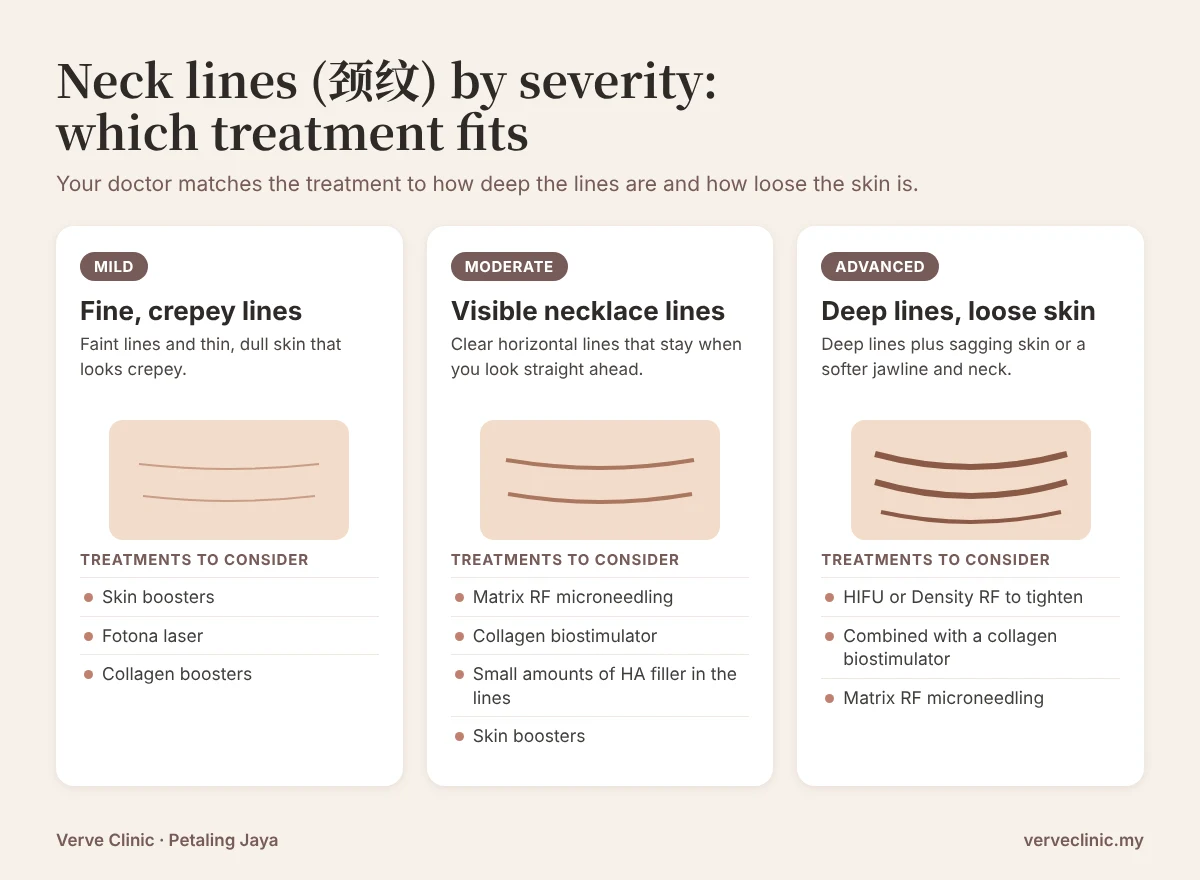
The right treatment depends on how deep your lines are and how loose the skin around them is. Your doctor will assess this at your consultation, but this guide shows how we usually match treatments to each stage.
Neck line treatments we offer
Skin boosters: for fine, crepey lines
Skin boosters are injected in tiny amounts across the neck to hydrate the skin and stimulate collagen. They improve skin quality, soften fine lines and give a smoother, healthier-looking neck. They are often the starting point for mild lines, and they combine well with other treatments. Compare the skin boosters we use.
Matrix RF microneedling (翡翠电波): for visible lines and texture
Matrix RF microneedling uses fine needles to deliver radiofrequency energy inside the skin, stimulating new collagen and tightening it from within. It suits visible neck lines together with crepey texture and mild looseness.
Collagen biostimulator: for firmer, thicker skin
A collagen biostimulator is an injectable that prompts the skin to rebuild collagen over the following weeks. It improves skin thickness and firmness across the neck, so lines become less noticeable. We often combine it with HIFU, Density RF or Matrix RF microneedling.
HA filler: for softening individual lines
For deeper individual lines, very small amounts of a soft hyaluronic acid filler can be placed directly into the line to soften it. Filler only fills the crease, so it works best alongside treatments that improve the skin itself.
HIFU and Density RF: for lines with loose skin
When neck lines come with sagging skin, tightening treatments help. HIFU (超声刀) focuses ultrasound energy deep under the skin to lift and tighten, while Density RF (无双电波) heats the full thickness of the skin for overall tightening, with no downtime. Our skin tightening guide compares them in detail.
Fotona laser: for skin quality
Fotona laser treatments heat the skin to stimulate collagen, smoothing fine lines and improving skin tone, without needles.
Neck line treatments compared
| Treatment | Best for | Downtime |
|---|---|---|
| Skin boosters | Fine, crepey lines and skin quality | Minimal, small bumps or redness |
| Matrix RF microneedling (翡翠电波) | Visible lines with texture and mild looseness | Mild redness for a short time |
| Collagen biostimulator | Thin, loose skin; firmer neck | Minimal |
| HA filler | Softening individual deep lines | Minimal |
| HIFU (超声刀) | Lines with sagging skin | Minimal, mild tenderness |
| Density RF (无双电波) | Overall tightening of the neck | None |
| Fotona laser | Fine lines and skin tone, no needles | Minimal |
Most people need a course of 3 to 5 sessions. Results usually appear about 1 month after treatment and last 9 months to 1 year, depending on the treatment.
How we combine treatments for neck lines
Neck lines usually involve both the skin’s surface and its deeper support, so combining treatments that work at different depths often gives a smoother, longer-lasting result. These are the combinations we use most:
- HIFU + a collagen biostimulator: HIFU tightens the deeper layers while the biostimulator rebuilds collagen in the skin.
- Matrix RF microneedling + a collagen biostimulator: smoother texture and softer lines, with firmer, thicker skin.
- Density RF + collagen boosters: full-thickness tightening with no downtime, plus better skin quality.
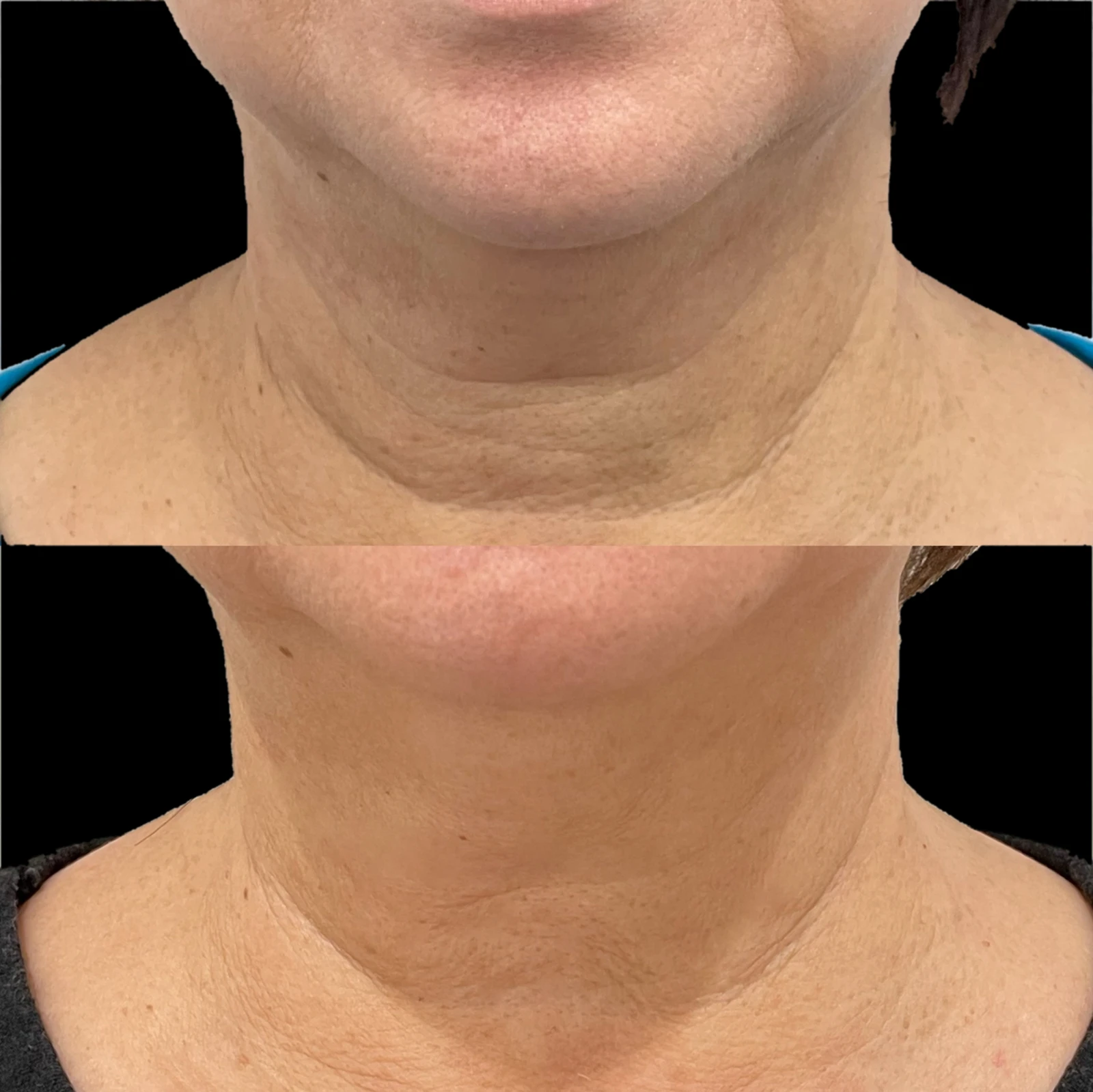
Neck lines before and after
This is a real patient treated at Verve Clinic. Results vary from person to person.
Who is neck line treatment suitable for?
Neck line treatment suits adults who are bothered by horizontal lines across the neck, crepey or thinning neck skin, or a neck that looks older than their face. Most of the patients we see for neck lines are aged 30 and above. It is also a good next step for people who already treat their face and want the neck to match, because many treatments can cover both areas in the same visit.
Your doctor will review your medical history and examine the skin before recommending a plan. If you have an active skin infection or irritation on the neck, treatment is usually postponed until the skin has settled.
What happens during neck line treatment?
Most neck line treatments are done in the clinic in under an hour, and you can return to your day straight afterwards. This is what to expect:
- Consultation: your doctor assesses how deep your lines are and how loose the skin is, and plans the treatment or combination that suits you.
- Numbing: numbing is used where needed, so the treatment is comfortable.
- Treatment: the chosen treatment is carried out across the neck, often at the same visit as the face.
- Aftercare: expect minimal redness or swelling, or none at all.
- Course and review: most people need 3 to 5 sessions, and smoother skin is usually visible about 1 month after treatment.
What about a sagging neck or neck bands?
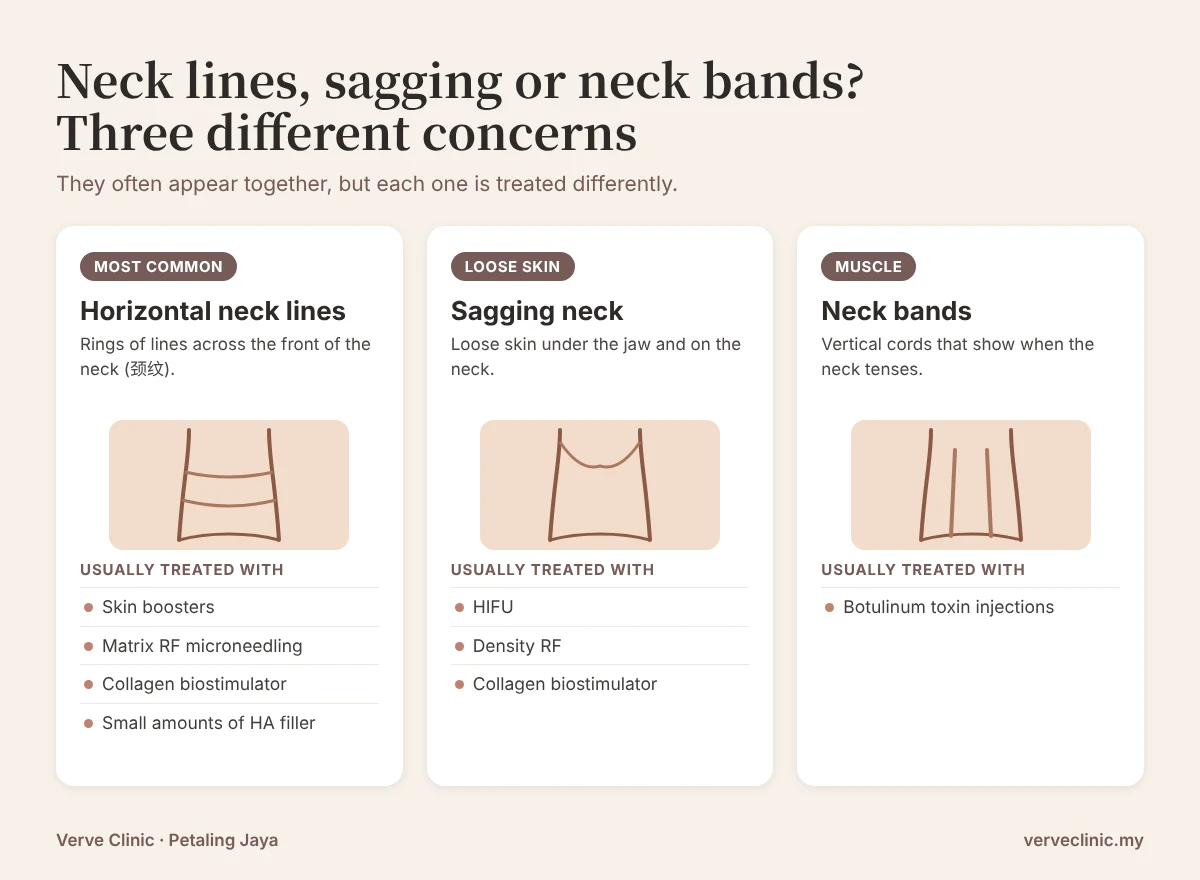
A loose or sagging neck is usually treated with tightening treatments such as HIFU and Density RF, often with a collagen biostimulator, as described above.
Neck bands are vertical cords that appear when the neck muscle, called the platysma, becomes more visible with age. They are different from horizontal lines and are usually softened with small injections of botulinum toxin, sometimes called a Nefertiti neck lift. Our anti-wrinkle injections guide explains how these injections work.
What results can you expect?
A note from Dr. Adriene Chee: “Neck lines are often the first sign of ageing people notice and the last area they treat. The neck needs the same care as the face. With the right combination, most people see smoother, firmer skin within about a month, and the lines become much less noticeable. Deep lines rarely disappear completely, but the neck can look years fresher and match the face again.”
| Neck line treatment quick facts | |
|---|---|
| Sessions | Usually a course of 3 to 5 |
| Downtime | Minimal redness or swelling, or none |
| Results visible | About 1 month after treatment |
| Results last | 9 months to 1 year, depending on the treatment |
| Who we see most | Patients aged 30 and above |
How much does neck line treatment cost in Malaysia?
The cost depends on how deep your lines are, which treatments you need and how many sessions. That is why we give a personalised quote after your consultation, rather than a fixed package.
Frequently asked questions
What causes horizontal neck lines?
Horizontal neck lines form because neck skin is thin and loses collagen with age, and because the neck bends thousands of times a day. Sun exposure, genetics and weight changes add to them. Some people have faint neck lines from a young age because of how their skin and fat sit.
Can neck lines be removed completely?
Neck lines can be softened a lot, but deep lines rarely disappear completely. The aim is smoother, firmer skin where the lines are much less noticeable.
What is the best treatment for neck lines?
There is no single best treatment. Fine, crepey lines often respond to skin boosters or laser, visible lines to Matrix RF microneedling, a collagen biostimulator or small amounts of filler, and deep lines with loose skin to HIFU or Density RF combined with a collagen biostimulator.
How many sessions do I need for neck lines?
Most people need a course of 3 to 5 sessions, depending on how deep the lines are and which treatments are combined.
Is there downtime after neck line treatment?
Downtime is minimal. You may have mild redness or swelling for a short time, and with some treatments there is no downtime at all.
When will I see results?
Most people notice smoother skin about 1 month after treatment, and results keep improving as new collagen forms.
How long do results last?
Results usually last 9 months to 1 year, depending on the treatment. Maintenance sessions help keep the neck smooth.
Does neck line treatment hurt?
Most people find it comfortable. Numbing is used where needed, and you may feel warmth, mild pressure or small pinpricks depending on the treatment.
Will neck lines come back after treatment?
Treatment smooths existing lines and builds collagen, but the neck keeps ageing and bending every day. Results usually last 9 months to 1 year, and maintenance sessions help keep the neck smooth for longer.
Is filler safe for neck lines?
When a doctor uses very small amounts of a soft hyaluronic acid filler placed carefully into the lines, it is generally safe. It is usually combined with other treatments that improve the skin itself.
Can I treat neck lines at the same time as my face?
Yes. Many treatments, such as HIFU, Density RF and skin boosters, can treat the face and neck in the same session, so the neck matches the face.
At what age do neck lines start?
Most of our patients with neck lines are 30 and above, but faint lines can appear earlier in some people.
What are neck bands, and are they the same as neck lines?
No. Neck bands are vertical cords that appear when the neck muscle (the platysma) becomes more visible with age. They are treated differently, usually with small injections of botulinum toxin to relax the muscle.
What are 颈纹, 去颈纹 and garis leher?
颈纹 is the Chinese term for neck lines, and 去颈纹 means removing neck lines. Garis leher is the Malay term for neck lines.
How much does neck line treatment cost in Malaysia?
It depends on how deep the lines are, which treatments you need and how many sessions. WhatsApp us for a personalised quote after your consultation.
Ready for a smoother, younger-looking neck?
If you are looking for neck line treatment in Petaling Jaya, Verve Clinic welcomes patients from Kuala Lumpur, PJ and across the Klang Valley. A doctor will assess your neck, explain which treatments suit your lines and plan a course that fits you. WhatsApp us to arrange your consultation and a personalised quote.
About the author
Dr. Adriene Chee is the Medical Director of Verve Clinic in Petaling Jaya. She has more than 10 years of experience. Her qualifications include an MD from the National University of Malaysia (UKM), a Postgraduate Diploma in Dermatology (Bangkok) and an LCP in Aesthetic Medicine. Meet our team.
This article is general information, not medical advice. Results vary from person to person. Please discuss the benefits and risks of any treatment with a qualified doctor.