You have been diligent. Sunscreen every morning, a serum that cost more than you would like to admit, months of patience. Yet the brown patches are still there — faded on a good week, back after one weekend outdoors. Pigmentation is among the most common concerns we see at Verve Clinic, and the most demoralising, because it returns just as you think you have won.
In short: PicoWay® laser is a picosecond system from Candela that delivers energy in trillionths of a second. Instead of heating pigment until it burns away, it breaks pigment apart mechanically — less heat, less risk, and a better safety margin for Asian skin. Most pigmentation programmes run 3 to 6 sessions at 4-week intervals, with visible change 1 to 2 weeks after each. Melasma, however, is chronic: PicoWay manages it well, but does not cure it.
What is PicoWay® laser?
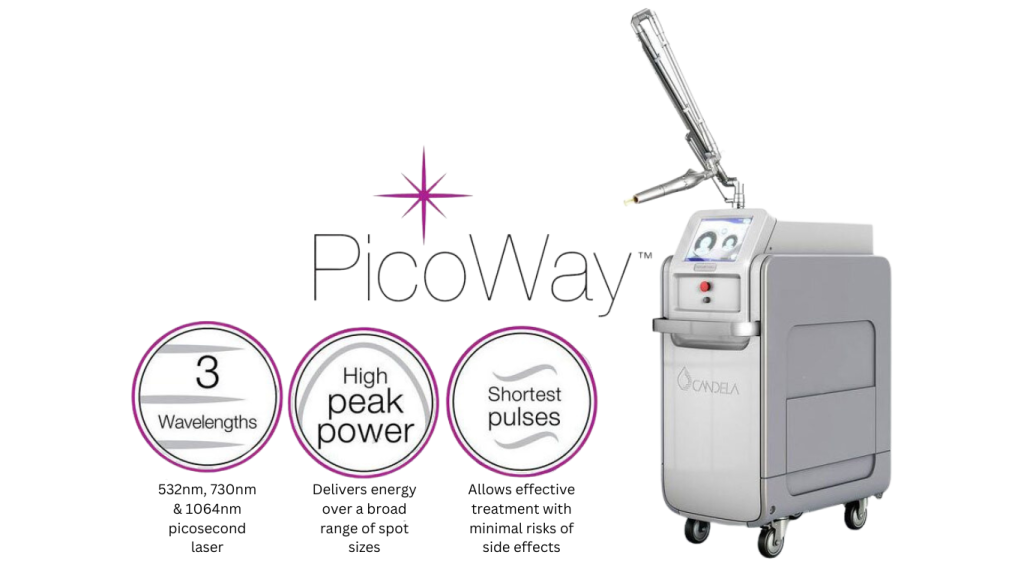
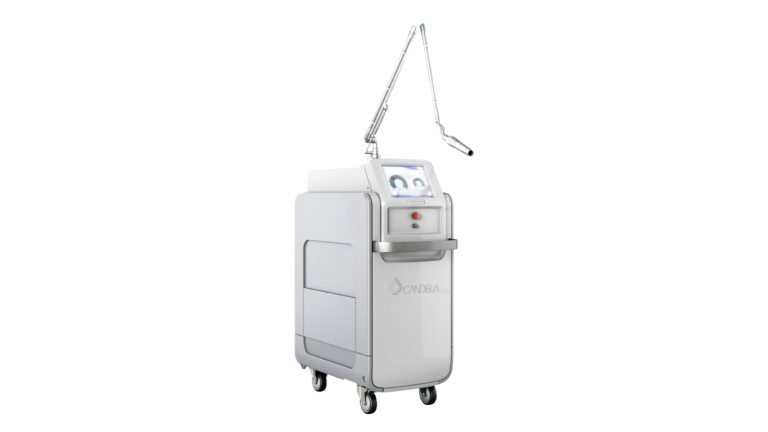
PicoWay is a medical picosecond laser made by Candela, known in Chinese as 超皮秒. The name refers to its pulse duration: energy is delivered in picoseconds, or trillionths of a second. Candela specifies pulses as short as 250 picoseconds — around a thousand times shorter than the nanosecond pulses of older pigment lasers.
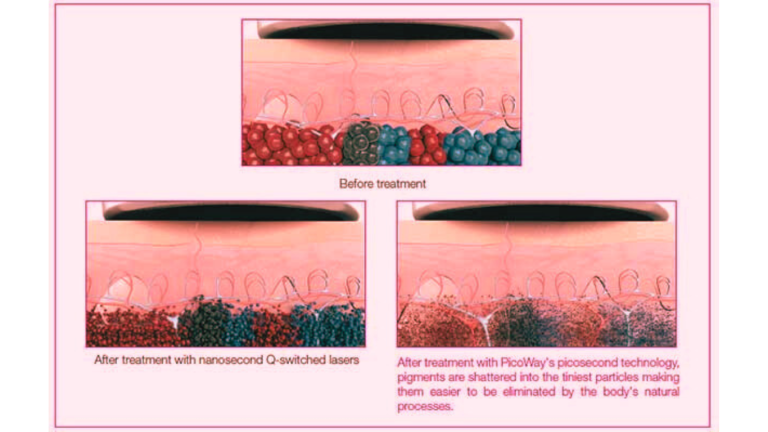
That speed changes the physics. A slower laser works by heat: pigment absorbs energy, warms up and breaks down thermally, with heat spreading into surrounding tissue. A picosecond pulse ends before meaningful heat spreads. Instead it creates a photoacoustic effect — a pressure wave that shatters pigment into particles fine enough for your body to clear naturally.
Less heat matters enormously here. Heat drives post-inflammatory hyperpigmentation, the darkening that can follow aggressive laser treatment in deeper skin tones — a documented risk in Asian skin, which is prone to laser-induced pigment change and burns.
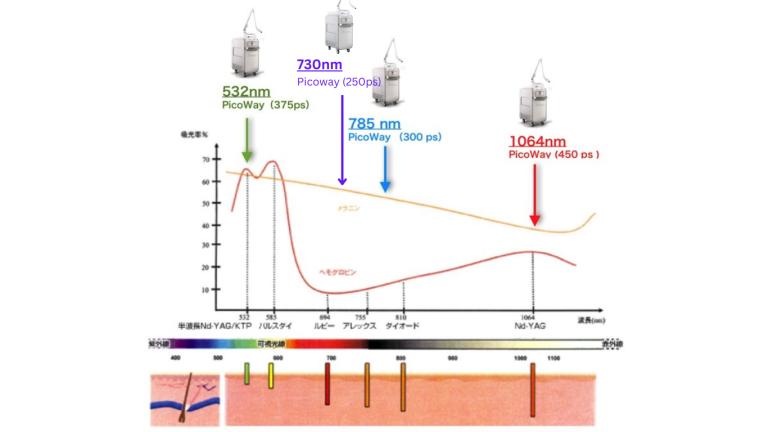
At Verve we run three of PicoWay’s wavelengths — 532 nm, 730 nm and 1064 nm — with both the Zoom and Resolve handpieces:
- 532 nm — superficial pigment: freckles, sun spots, red and orange ink
- 730 nm — stubborn blues, greens and resistant pigment
- 1064 nm — deeper dermal pigment, darker inks, low-fluence toning
- Zoom — full-beam work on discrete lesions and tattoos
- Resolve — a fractional beam for texture, scars, pores and fine lines
Matching wavelength to pigment depth and colour is the difference between clearing a lesion and merely irritating it. The platform holds FDA 510(k) clearance for tattoo removal, benign pigmented lesions, lentigines, acne scars, wrinkles and — since 2022 — melasma.
Why does pigmentation form — and why does it keep coming back?
Pigment is produced by melanocytes, cells that manufacture melanin as a protective response. Ultraviolet light switches them on above all, but so do heat, hormones, inflammation from acne, and friction.
Pigmentation recurs because the trigger usually remains — clearing existing pigment does nothing to switch off an overactive melanocyte. This is especially true of melasma, driven by hormones and UV together, which behaves less like a stain to be removed and more like a chronic condition to be managed. Malaysia’s year-round equatorial UV does the rest.
Is PicoWay good for melasma and pigmentation?
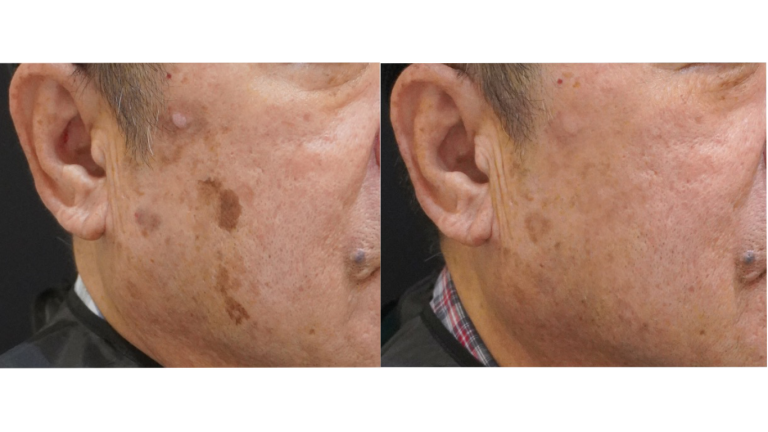
For most pigmented lesions — freckles, sun spots, age spots, post-acne marks — PicoWay is an excellent choice, with results typically visible 1 to 2 weeks after a session.
Melasma deserves a more careful answer. Low-fluence 1064 nm toning is one of the more reliable tools we have, and the evidence is wavelength-specific: a 2023 systematic review and meta-analysis found 1064 nm picosecond laser significantly improved melasma severity scores without significant side effects, while 755 nm did not outperform topical agents and was associated with post-inflammatory hyperpigmentation. Still, walk in with the right expectation:
- It is chronic. Treatment lightens and controls melasma; it does not cure it.
- It can rebound. Aggressive settings make melasma worse, which is why a low-heat approach suits it.
- It rarely responds to laser alone. Our best results combine PicoWay with daily sunscreen, topicals and, where suitable, oral therapy prescribed at consultation. We may also layer in skin boosters for hydration and barrier function, or RF microneedling, which calms the overactive vessels feeding a patch and helps repair the basement membrane — the layer that keeps pigment cells where they belong.
- It needs maintenance. Most patients settle into periodic top-ups rather than a course that finishes for good.
If a clinic promises to clear your melasma permanently in three sessions, be sceptical. We would rather set an honest expectation and exceed it.
What is the difference between picosecond and Q-switched lasers?
A picosecond laser breaks pigment by mechanical pressure; a Q-switched nanosecond laser breaks it with heat. That change in mechanism alters the safety profile, the sessions needed and the recovery.
| PicoWay® (picosecond) | Traditional Q-switched (nanosecond) | |
|---|---|---|
| Pulse duration | From 250 picoseconds | Roughly a thousand times longer |
| Mechanism | Photoacoustic — pressure shatters pigment | Photothermal — heat breaks pigment down |
| Heat to surrounding skin | Minimal; the pulse ends before heat spreads | Higher, with more thermal spread |
| Risk in deeper skin tones | Lower risk of post-inflammatory hyperpigmentation | Greater care required; heat is the main risk |
| Recovery | Mild redness, usually settling within hours | Often longer and more visible |
Within picosecond lasers, Candela positions PicoWay as delivering three times more power and twice the speed of other picosecond systems, with a significantly quicker recovery time, and describes it as the only system delivering a pure picosecond pulse.
What else does PicoWay treat?
- Tattoo and birthmark removal — multiple wavelengths cover a wide range of inks
- Acne scars — the Resolve handpiece remodels texture without breaking the surface
- Fine lines and wrinkles — fractional energy triggers collagen and elastin
- Skin rejuvenation and open pores — tone and clarity
- Stretch marks — texture and colour
How many PicoWay sessions will I need?
Most pigmentation and rejuvenation programmes run 3 to 6 sessions at 4-week intervals, with visible change 1 to 2 weeks after each. Tattoo removal needs at least 5 sessions, often more — ink colour, depth and age all change the arithmetic. Melasma adds ongoing maintenance after the initial course.
The 4-week gap is not arbitrary: it gives your immune system time to clear the shattered pigment before the next pass.
What is a PicoWay treatment like?
| Treatment time | Typically 15 to 30 minutes, depending on the area |
| Downtime | Minimal; mild redness usually settling within a few hours |
| Comfort | A light flicking sensation; numbing cream available on request |
| Results | Visible 1 to 2 weeks after each session, building over the course |
| Sessions | 3 to 6 at 4-week intervals for pigmentation; at least 5 for tattoos |
| Skin surface | Left intact — makeup can usually be worn the following day |
Because PicoWay leaves the outer layer of skin unharmed, most patients return to normal activities the same day. What you will not get is an overnight transformation: clearance depends on your immune system carrying away the particles, which takes days to weeks.
What is aftercare like?
Daily broad-spectrum sunscreen, reapplied — this single step largely determines whether your results hold. Avoid deliberate sun, saunas and steam for a few days, keep the skin moisturised, pause retinoids and acids until it settles, and let flaking pigment shed on its own.
Is PicoWay right for you?
It tends to suit people bothered by:
- Freckles, sun spots and age spots
- Melasma, if you are prepared for management rather than a one-off fix
- Post-acne marks and uneven skin tone
- Acne scarring, enlarged pores, rough texture
- An unwanted tattoo, including multi-coloured
- Fine lines and early loss of skin quality
We would delay or advise against treatment for active skin infection, recent significant sun exposure, certain photosensitising medications and pregnancy. Only a proper assessment by a qualified doctor can tell you whether this is right for you.
PicoWay® laser: frequently asked questions
What is PicoWay laser?
PicoWay is a picosecond laser by Candela that delivers energy in trillionths of a second. Rather than heating pigment, it shatters it mechanically with a photoacoustic pressure wave. It treats pigmentation, melasma, tattoos, acne scars and fine lines.
Is PicoWay good for melasma?
Yes — low-fluence 1064 nm toning is one of the better tools available, supported by meta-analysis evidence. But melasma is chronic: PicoWay lightens and controls it rather than curing it, and usually needs maintenance alongside sun protection and topicals.
How many PicoWay sessions will I need?
Most pigmentation and rejuvenation programmes run 3 to 6 sessions at 4-week intervals, with results visible 1 to 2 weeks after each. Tattoo removal needs at least 5 sessions and often more, depending on the ink’s colour, depth and age.
Does PicoWay hurt, and is there downtime?
Most patients describe a light flicking sensation rather than pain, and numbing cream is available on request. Downtime is minimal — mild redness afterwards, usually settling within a few hours.
What are the side effects of PicoWay?
The most common is mild redness settling within a few hours. Some patients see slight swelling, or temporary darkening of spots before they flake away. Pinpoint bruising and pigment change are less common; blistering and scarring are rare.
Is PicoWay safe for darker Asian skin tones?
It is well suited to them. Heat is the main driver of post-inflammatory hyperpigmentation, and picosecond pulses generate very little of it. Safety still depends on correct wavelength and fluence, decided at consultation.
How much does PicoWay cost in Malaysia?
Cost depends on the concern, the area treated and the number of sessions your plan calls for, so pricing is tailored rather than fixed. WhatsApp us to arrange a consultation for an accurate quote.
Ready to stop covering it up?
Pigmentation is stubborn, but it does not have to be treated aggressively to be treated well. PicoWay offers a precise, low-heat way to clear pigment and refine skin quality, with a plan built around your skin.
Curious whether PicoWay suits you? WhatsApp us to arrange a consultation.
This article is general information only and not medical advice. Individual results, downtime and suitability vary. Any aesthetic procedure carries risks that should be discussed with a qualified medical practitioner before treatment.
About the author
Dr. Adriene Chee Jing Xian is the founder and resident aesthetic physician at Verve Clinic, Petaling Jaya. She holds a Letter of Credentialing and Privileging (LCP) in Aesthetic Medical Practice from the Malaysian Ministry of Health, and is registered with the Malaysian Medical Council (MMC 53808). She treats pigmentation and melasma in Asian skin daily.