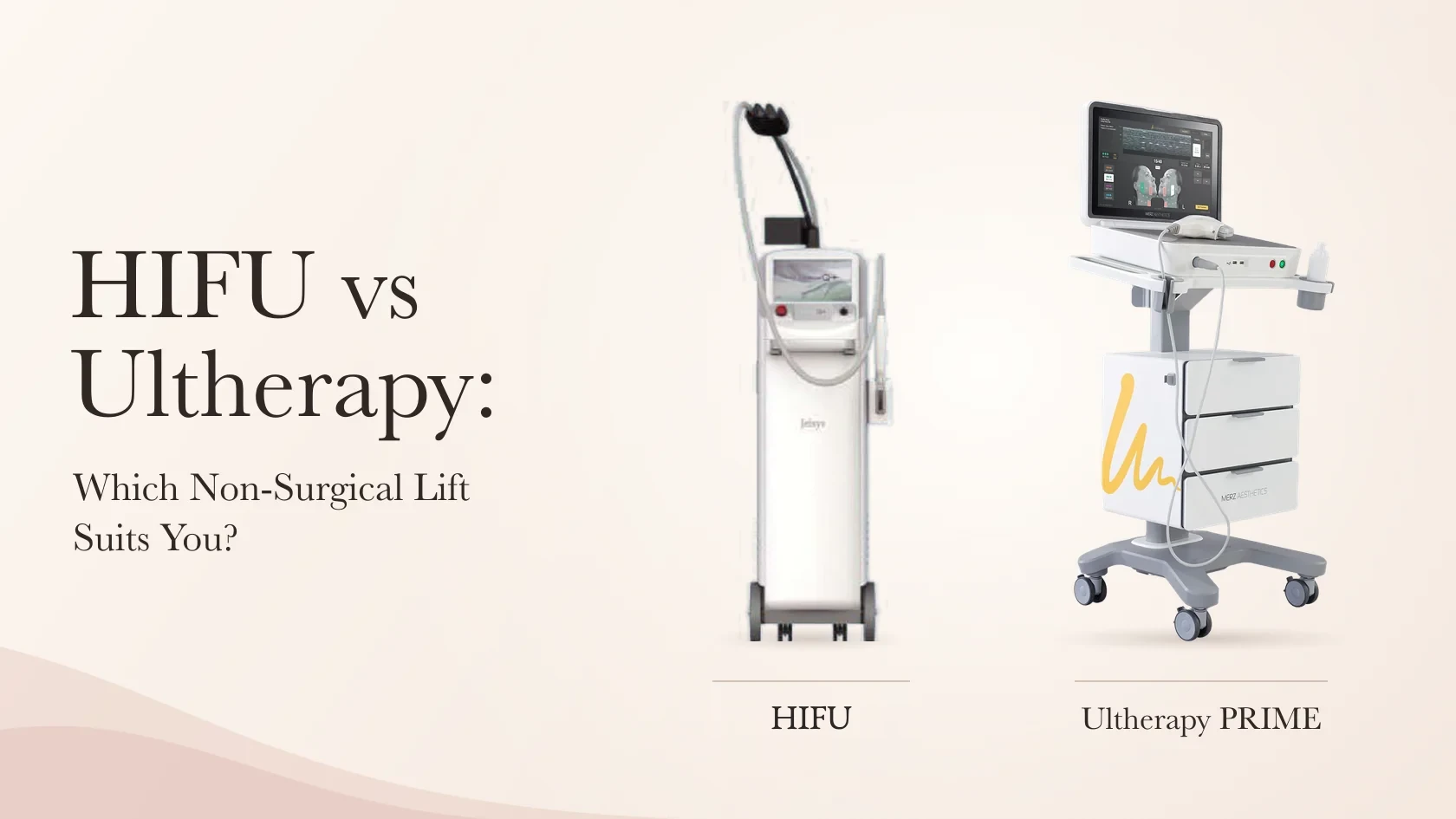
HIFU vs Ultherapy: which suits you? Both lift and tighten with focused ultrasound at the same depths. A doctor’s balanced comparison of how they differ in imaging, technique, comfort and price, to help you choose.
Medically reviewed by Dr. Adriene Chee, Medical Director, Verve Clinic. Last updated: 27 November 2026.
If you are looking for a non-surgical lift, two names come up again and again: HIFU (超声刀) and Ultherapy (美版超声刀). Both promise a firmer jawline, a lifted brow and tighter skin without surgery or time off work. So what is the difference, and is one really better than the other?
In this guide, Dr. Adriene Chee, a doctor with more than 10 years of experience, compares HIFU and Ultherapy side by side: how they work, the depths they reach, the role of the on-screen image, how many sessions they need, how they feel and how they are priced. This comparison is meant to help you make an informed choice wherever you are treated.
HIFU vs Ultherapy: the short answer
In short: HIFU and Ultherapy both use focused ultrasound to heat the same depths, 1.5, 3.0 and 4.5 mm, which triggers new collagen and gradually lifts the face and neck. Ultherapy adds a real-time image of the skin layers on a screen. HIFU has no screen, is usually milder and more affordable, and is given as a course.
What is HIFU (超声刀)?
HIFU stands for high-intensity focused ultrasound. In Chinese, it is often called 超声刀. A HIFU device sends ultrasound energy through the skin surface and focuses it into tiny points at set depths below it. According to a 2025 review in Applied Sciences, these points reach about 65 to 75°C. The heat tightens the tissue and triggers new collagen, so the face lifts and firms gradually over the following weeks.
HIFU is used to lift a softening jawline and early jowls, tighten loose skin under the chin and on the neck, and lift lowered brows. Our complete guide to HIFU treatment covers the research, side effects and what to expect in more detail.
What is Ultherapy (美版超声刀)?
Ultherapy is a branded focused ultrasound treatment made by Merz Aesthetics. Its technical name is microfocused ultrasound with visualisation (MFU-V). Like HIFU, it focuses ultrasound energy at set depths under the skin. What sets it apart is a built-in ultrasound image: during treatment, the practitioner can see the skin layers on a screen in real time.
Ultherapy has been used widely for many years. In 2024, its maker reported more than three million treatments worldwide and launched a newer version, Ultherapy PRIME. It is used to lift and tighten the face, brow, jawline, the skin under the chin and the neck, and to improve lines on the chest.
How do HIFU and Ultherapy work?
Both treatments work in the same way. Focused ultrasound passes harmlessly through the skin surface and becomes strong only at the focal point. There, it creates tiny heated points, which heal by forming new collagen. Because collagen builds slowly, the lift appears gradually rather than overnight.
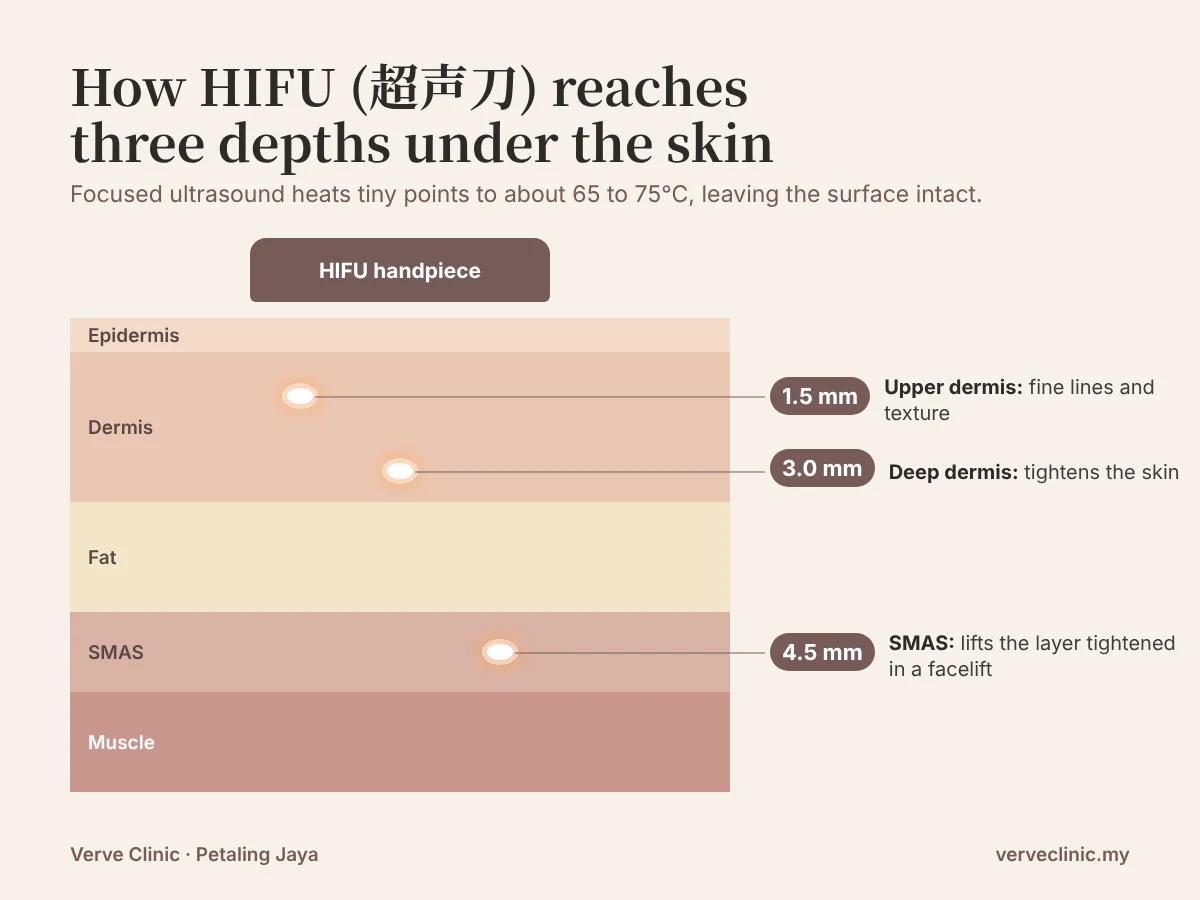
Both use different cartridges or transducers to reach different layers of the skin:
| Depth | Layer treated | What it does |
|---|---|---|
| 1.5 mm | Upper dermis | Improves fine lines and skin texture |
| 3.0 mm | Deep dermis | Tightens the skin and supports collagen |
| 4.5 mm | SMAS (the muscle and fibrous layer) | Lifts the deeper structure that holds the face up |
The SMAS is the same layer that surgeons lift during a facelift. Reaching it without a cut is what makes both HIFU and Ultherapy different from most facials and skin tightening devices.
HIFU vs Ultherapy side by side
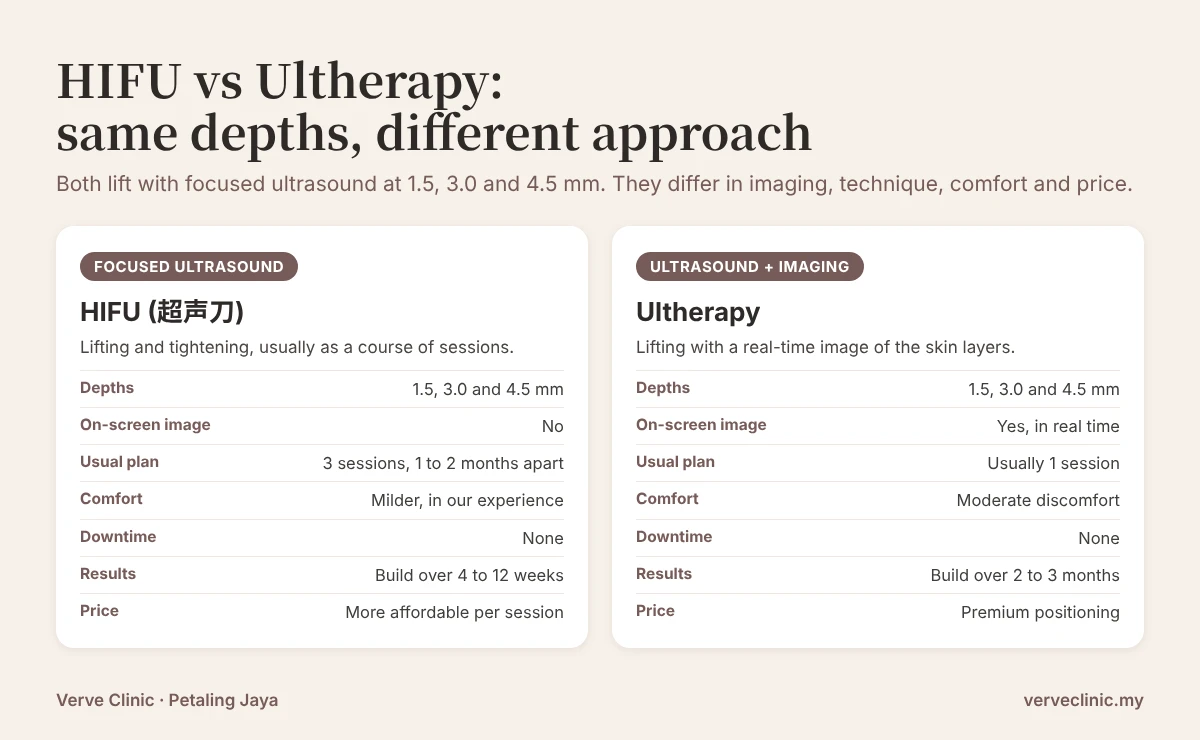
| HIFU (超声刀) | Ultherapy (美版超声刀) | |
|---|---|---|
| Energy | Focused ultrasound | Focused ultrasound with real-time imaging |
| Depths | 1.5, 3.0 and 4.5 mm | 1.5, 3.0 and 4.5 mm |
| On-screen image | No | Yes, the skin layers are shown on a screen |
| Main areas | Face, jawline, jowls, double chin, neck, eye area | Face, brow, jawline, under the chin, neck, chest |
| Usual plan | 3 sessions, 1 to 2 months apart, then maintenance | Usually 1 session |
| Comfort | Milder in our experience; numbing cream used | Moderate discomfort, about 5 out of 10 on average |
| Downtime | None | None |
| Results | Build over 4 to 12 weeks; about a year in our experience | Build over 2 to 3 months; up to a year or more, according to its maker |
| Price positioning | More affordable per session | Premium |
Key differences explained
1. The on-screen image
This is the clearest difference. Ultherapy shows the skin layers on a screen, so the practitioner can confirm that the transducer is in good contact and that the energy is placed at the intended depth. With HIFU, there is no screen. The doctor relies on knowledge of facial anatomy, the fixed depth of each cartridge and careful technique to place the energy correctly.
2. The same depths
Both treatments reach the same three depths, from the upper dermis to the SMAS. The image does not let Ultherapy reach deeper. It helps the practitioner see where the energy goes.
3. Technique and sessions
Ultherapy is usually given as a single, thorough session. HIFU is usually given as a course: we recommend 3 sessions, 1 to 2 months apart, followed by maintenance. Spreading the treatment over several sessions lets the lift build in steps and allows the plan to be adjusted as your skin responds.
4. Comfort
Ultherapy is known for moderate discomfort. A 2024 review of 42 studies in the Aesthetic Surgery Journal found an average pain score of about 5 out of 10, and some clinics offer pain relief medicines for it. In our experience, HIFU is usually milder. We apply numbing cream first and adjust the energy to your comfort.
5. Price positioning
Ultherapy is positioned as a premium, branded treatment, and one session usually costs more than a session of HIFU. HIFU is more affordable per session, which makes a full course and regular maintenance more realistic for many people.
Does the on-screen image make Ultherapy better?
The image is a genuine advantage: it helps confirm good contact and correct placement, especially for less experienced practitioners. Both treatments have published evidence. The 2024 review of Ultherapy reported that investigators rated 89% of patients as improved. For HIFU, a study of Korean patients in the Annals of Dermatology found improvement in all seven facial areas treated at 3 and 6 months.
In practice, results depend on more than the screen. The doctor’s understanding of facial anatomy, the choice of depths, the number of shots and the energy used for each area all shape the outcome. A skilled doctor using HIFU and a skilled practitioner using Ultherapy can both give a natural lift.
What about Ultherapy PRIME?
Ultherapy PRIME is the newer version of the Ultherapy platform, launched by Merz Aesthetics in 2024. According to its maker, it has a 35% larger screen and a faster image refresh rate than the previous version. It uses the same treatment principle and depths, and is still usually given as one session.
Which should you choose?
- HIFU may suit you if: you want a gradual, natural lift of the jawline, jowls, double chin or neck; you prefer a milder treatment with numbing cream; and you would like a more affordable course with regular maintenance.
- Ultherapy may suit you if: you value real-time imaging and prefer to have one session, and you are comfortable with moderate discomfort and a premium price.
- Neither may be right if: you have heavy, advanced sagging, where surgery gives a better result, or your main concern is lost volume, which a collagen biostimulator or filler may address better.
Whichever you choose, ask how many treatments the doctor has done, which depths they plan to use for your face, and how they avoid overheating and fat loss.
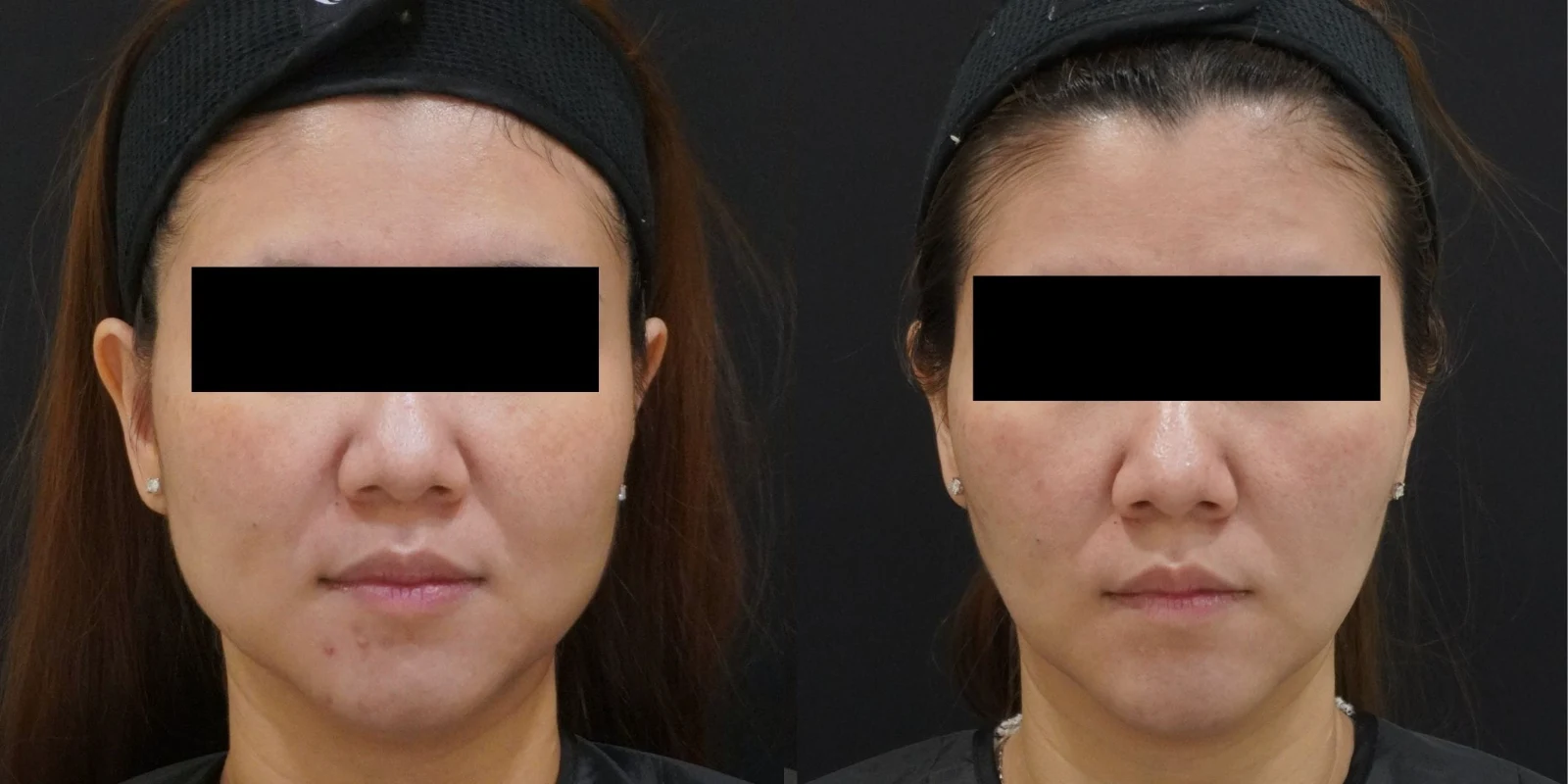
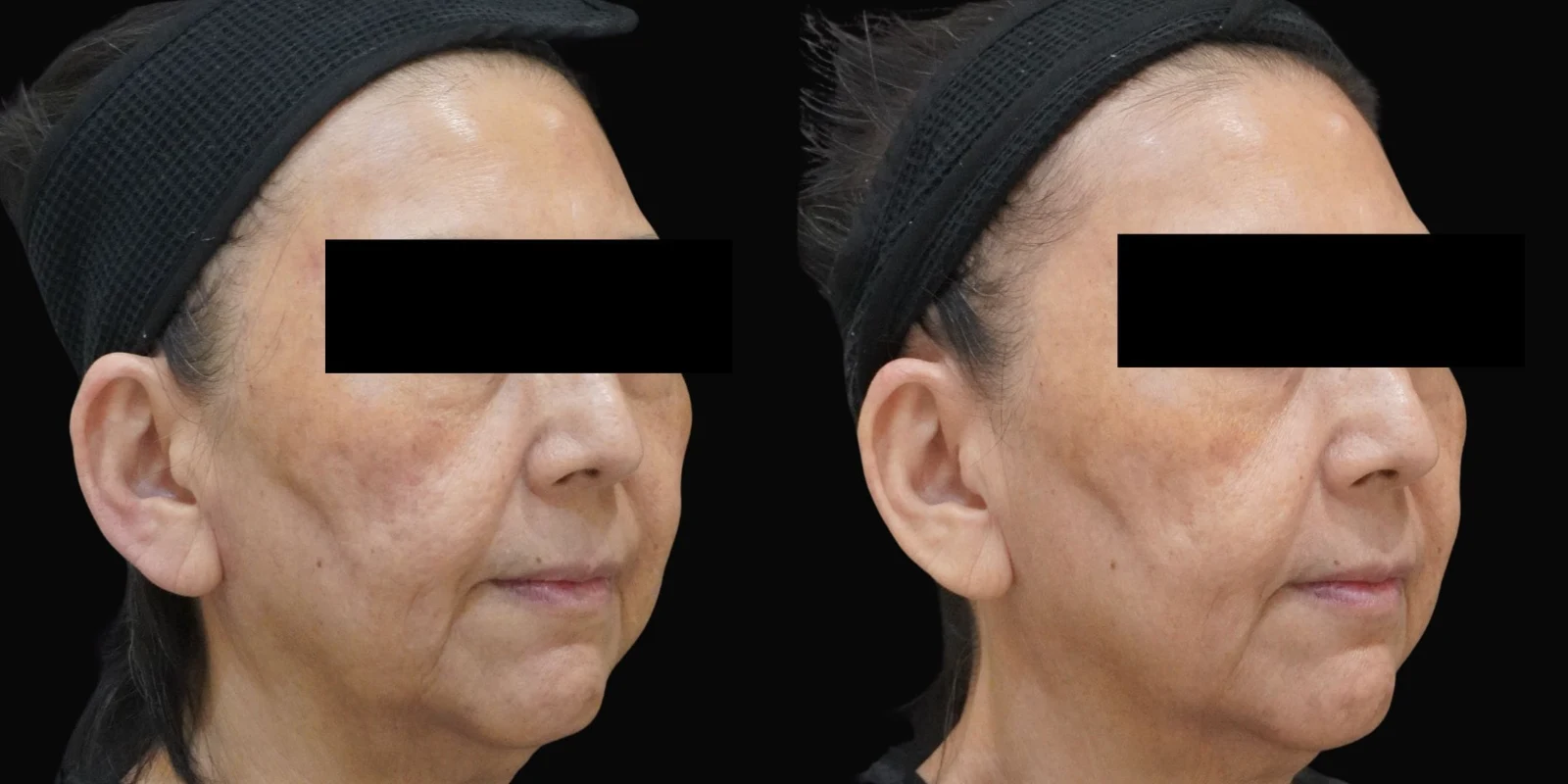
HIFU before and after
These are real patients treated with HIFU at Verve Clinic. Results vary from person to person.
A doctor’s view
A note from Dr. Adriene Chee: “HIFU and Ultherapy work on the same principle and reach the same depths. The on-screen image is a useful guide, but the result depends far more on understanding facial anatomy and placing the energy carefully. For most of my patients, a course of HIFU gives a natural lift with less discomfort, at a cost that makes maintenance realistic.”
| HIFU vs Ultherapy quick facts | |
|---|---|
| Both are | Focused ultrasound treatments that lift and tighten by building new collagen |
| Same depths | 1.5, 3.0 and 4.5 mm, down to the SMAS layer |
| Ultherapy advantage | Real-time image of the skin layers on a screen |
| HIFU advantage | Milder treatment, no downtime and more affordable per session |
Common myths about HIFU and Ultherapy
- Myth: Ultherapy reaches deeper than HIFU. Both reach the same depths. The image shows where the energy goes, but does not take it deeper.
- Myth: HIFU is a cheaper copy of Ultherapy. HIFU is the broader technology, and Ultherapy is one branded form of it. Both are focused ultrasound, and both have published evidence.
- Myth: you see the full result the next day. Some tightening may show early, but the real lift builds over weeks as new collagen forms.
- Myth: more energy always gives a better lift. Excessive heat or repeated passes over the same area can cause fat loss. The right settings matter more than the highest settings.
What to expect during HIFU at Verve Clinic
A HIFU session at Verve Clinic takes 60 to 80 minutes, including numbing. Most people go back to work the same day.
- Assessment. Your doctor assesses your skin laxity, facial structure and goals, and confirms whether HIFU is the right treatment for you.
- Your plan. We decide which areas to treat, the depths to use and how many shots each area needs.
- Numbing. Numbing cream is applied to keep you comfortable.
- Treatment. The handpiece is moved across each area in lines. You will feel warm, prickling pulses, strongest along the jawline, and we adjust the energy to your comfort.
- After treatment. Mild redness usually settles within a few hours, and mild tenderness may last a few days.
Combining HIFU with other treatments
HIFU lifts the deeper structure of the face. For a balanced result, it is often combined with treatments that work in a different way:
- Density RF to tighten the skin above the lifted layers.
- AestheFill collagen biostimulator to restore firmness and lost volume. Our guide to AestheFill vs Sculptra explains how collagen biostimulators compare.
- Aptos thread lift to reposition sagging tissue that needs more lift.
- HIFU for the eye area to lift hooded brows and tighten the skin around the eyes.
- Treatments for a double chin, when fat under the chin is part of the concern.
Your doctor will advise the order and timing, as some treatments are best spaced a few weeks apart. Our skin tightening and lifting guide compares more options.
How much does HIFU cost in Malaysia?
The cost depends on the areas treated, the number of shots and the number of sessions. That is why we give a personalised quote after your consultation, rather than a fixed package.
Frequently asked questions
What is the difference between HIFU and Ultherapy?
Both use focused ultrasound to heat the same depths under the skin, 1.5, 3.0 and 4.5 mm, to lift and tighten. The main difference is that Ultherapy shows a real-time image of the skin layers on a screen, while HIFU does not. They also differ in technique, comfort and price positioning.
Is Ultherapy a type of HIFU?
Yes, in a broad sense. Ultherapy is a branded form of focused ultrasound, also called microfocused ultrasound with visualisation. It works on the same principle as HIFU, with an added on-screen image.
Which is better, HIFU or Ultherapy?
Neither is better for everyone. Both can give a natural lift when the right depths and settings are used. Ultherapy offers real-time imaging, while HIFU is usually more comfortable and more affordable, which makes a course of sessions and maintenance easier. The doctor’s skill matters as much as the device.
Do HIFU and Ultherapy reach the same depth?
Yes. Both use cartridges or transducers that focus energy at about 1.5 mm, 3.0 mm and 4.5 mm, reaching from the upper dermis down to the SMAS layer that surgeons tighten in a facelift.
Which is more painful, HIFU or Ultherapy?
Ultherapy is known for moderate discomfort, rated about 5 out of 10 on average in a 2024 review. In our experience, HIFU is usually milder, especially with numbing cream and energy adjusted to your comfort.
How many sessions do I need?
Ultherapy is usually given as one session. With HIFU, we usually recommend 3 sessions, 1 to 2 months apart, followed by maintenance.
How long do results last?
With HIFU, results last about a year in our experience, with maintenance after that. Ultherapy’s manufacturer says results can last up to a year or more.
Is there downtime after HIFU or Ultherapy?
Neither needs downtime. You may have mild redness for a few hours and mild tenderness for a few days, and most people go back to work the same day.
When will I see results?
With both, some tightening may show soon after treatment, but the real lift builds gradually as new collagen forms, over about 4 to 12 weeks.
Can HIFU or Ultherapy make my face look hollow?
Fat loss has been linked to overheating from incorrect settings or repeated passes over the same area. Choosing a doctor who adjusts the depths, energy and number of shots to your face reduces this risk.
What is Ultherapy PRIME?
Ultherapy PRIME is the newer version of the Ultherapy platform, launched in 2024. Its maker describes a larger screen and a faster image refresh rate. The treatment principle and depths are the same.
What are 超声刀 and 美版超声刀?
超声刀 is the common Chinese name for HIFU. Ultherapy is often called 美版超声刀, which means the American 超声刀, because it was developed in the United States.
Who should not have HIFU or Ultherapy?
Treatment is postponed during pregnancy, with an infection or open wound in the area, or with certain implants in the treatment area. Heavy, advanced sagging usually responds better to surgery.
How much does HIFU cost in Malaysia?
It depends on the areas treated, the number of shots and the number of sessions. WhatsApp us for a personalised quote after your consultation.
Thinking about a non-surgical lift?
If you are considering HIFU in Petaling Jaya, Verve Clinic welcomes patients from Kuala Lumpur, PJ and across the Klang Valley. A doctor will assess your face, explain whether HIFU suits you, and plan a treatment that gives a natural, lifted result. WhatsApp us to arrange your consultation and a personalised quote.
About the author
Dr. Adriene Chee is the Medical Director of Verve Clinic in Petaling Jaya. She has more than 10 years of experience. Her qualifications include an MD from the National University of Malaysia (UKM), a Postgraduate Diploma in Dermatology (Bangkok) and an LCP in Aesthetic Medicine. Meet our team.
This article is general information, not medical advice. Results vary from person to person. Product names are trademarks of their respective owners. Please discuss the benefits and risks of any treatment with a qualified doctor.