Tired of shaving, waxing, ingrown hairs and dark underarms? How laser hair removal (激光脱毛) works, whether it is really permanent, why the right laser matters for Asian and tanned skin, and what to expect at Verve Clinic
Medically reviewed by Dr. Adriene Chee, Medical Director, Verve Clinic. Last updated: 3 November 2026.
Shave, and the stubble is back in two days. Wax, and you wait weeks for the hair to grow long enough to wax again, then deal with the bumps and ingrown hairs afterwards. Over time, the underarms or bikini line can turn darker from all the irritation. If you are tired of the routine, laser hair removal is the long-term answer many people wish they had started sooner.
In this guide, Dr. Adriene Chee, a doctor with more than 10 years of experience, explains how laser hair removal works, what “permanent” really means, why the type of laser matters for Asian and tanned skin, and how to choose a clinic you can trust.
What is laser hair removal (激光脱毛)?
In short: Laser hair removal (激光脱毛, or buang bulu laser in Malay) uses laser light to heat and disable the hair root, so less hair grows back. After a full course of usually 6 to 8 sessions, about 1 month apart, most people have far less hair, and what grows back is finer and lighter. The result is permanent hair reduction: many patients are left with almost no visible hair, and occasional top-up sessions help keep it that way.
The laser targets melanin, the pigment in the hair. The light is absorbed by the hair and turned into heat, which travels down to the root (the follicle) and damages the cells that produce new hair. At Verve Clinic, we use the Fotona long-pulsed Nd:YAG laser, with cooling throughout the treatment to protect the skin surface.
Is laser hair removal really permanent?
Laser hair removal gives permanent hair reduction, which is not quite the same as permanent hair removal. The US Food and Drug Administration defines permanent hair reduction as a long-term, stable reduction in the number of hairs that regrow after a course of treatment. It does not mean that every hair is gone.
In practice, this means:
- most hairs that are treated during their growth phase do not grow back
- the hairs that do grow back are usually finer, lighter and slower growing
- a few hairs may return over time, especially with hormonal changes, so occasional top-up sessions keep the result
The research reflects this. In a study of 150 patients with darker skin treated with a long-pulsed Nd:YAG laser, published in Lasers in Medical Science, the average hair reduction was 54.3% after an average of 8.9 sessions, and regrowth was slower and finer in 79.3% of patients. In a randomised trial in the British Journal of Dermatology, the same type of laser reduced underarm hair by 79.4% six months after five sessions.
A note from Dr. Adriene Chee: “Laser hair removal gives a permanent reduction in hair. After a full course, most of my patients see very little regrowth, often almost none, and any hair that does return is finer and lighter. It also helps prevent folliculitis and ingrown hairs, and many patients notice the treated area looks smoother and brighter.”
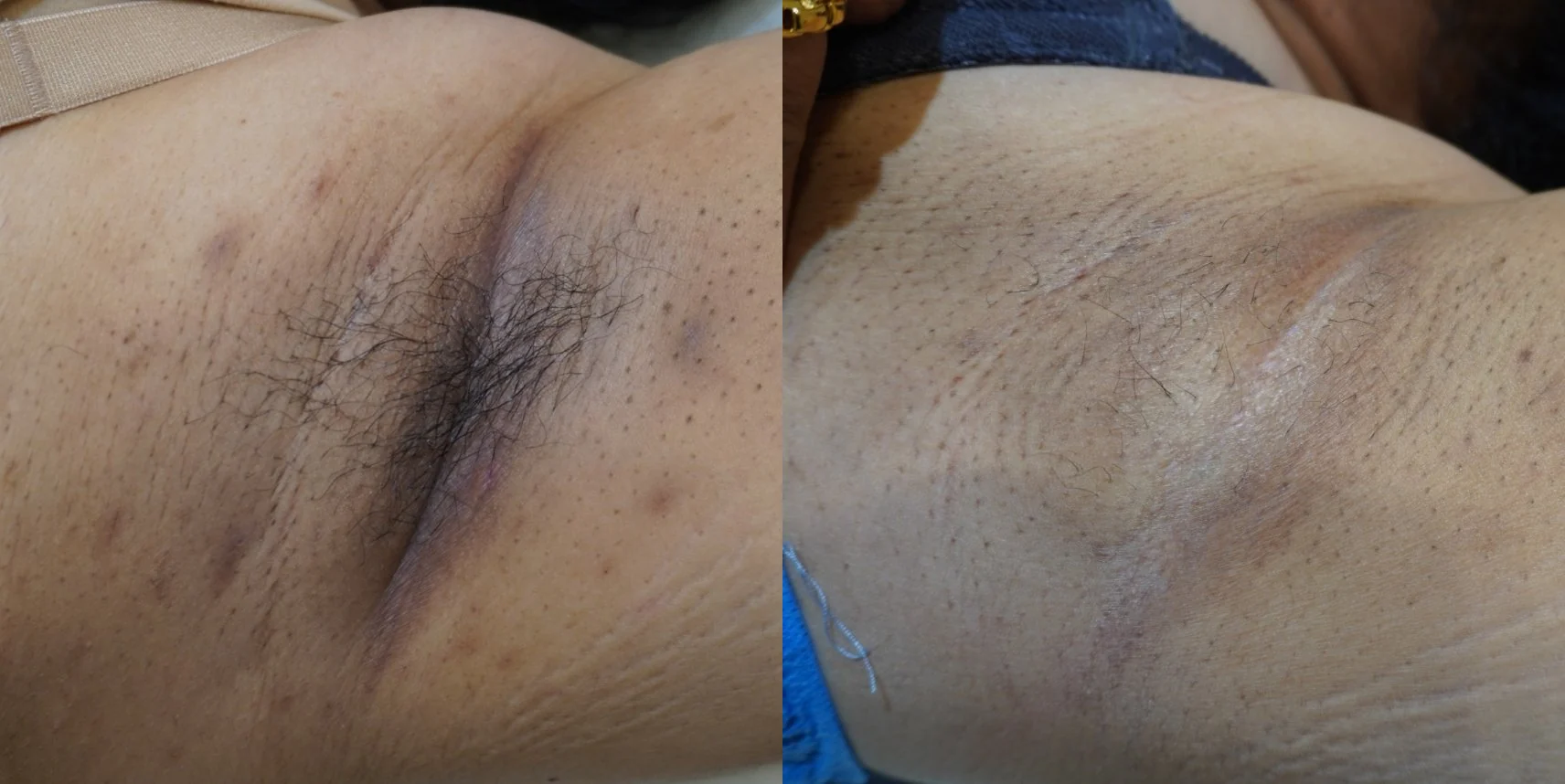
Laser hair removal before and after
This is a real patient treated at Verve Clinic. Results vary from person to person.
Why do you need several sessions?
Hair grows in cycles, and laser hair removal only works on hairs in their active growth phase (anagen), when the hair is still attached to the root. At any one time, only some of your hairs are in this phase. The others are resting or shedding, and will enter the growth phase later.
| Hair growth phase | What happens | Does laser work? |
|---|---|---|
| Growth (anagen) | The hair is actively growing and attached to the root | Yes, this is when laser works best |
| Transition (catagen) | The hair stops growing and detaches from the root | Less effective |
| Resting (telogen) | The old hair sheds and a new one prepares to grow | No, the hair is not attached to an active root |
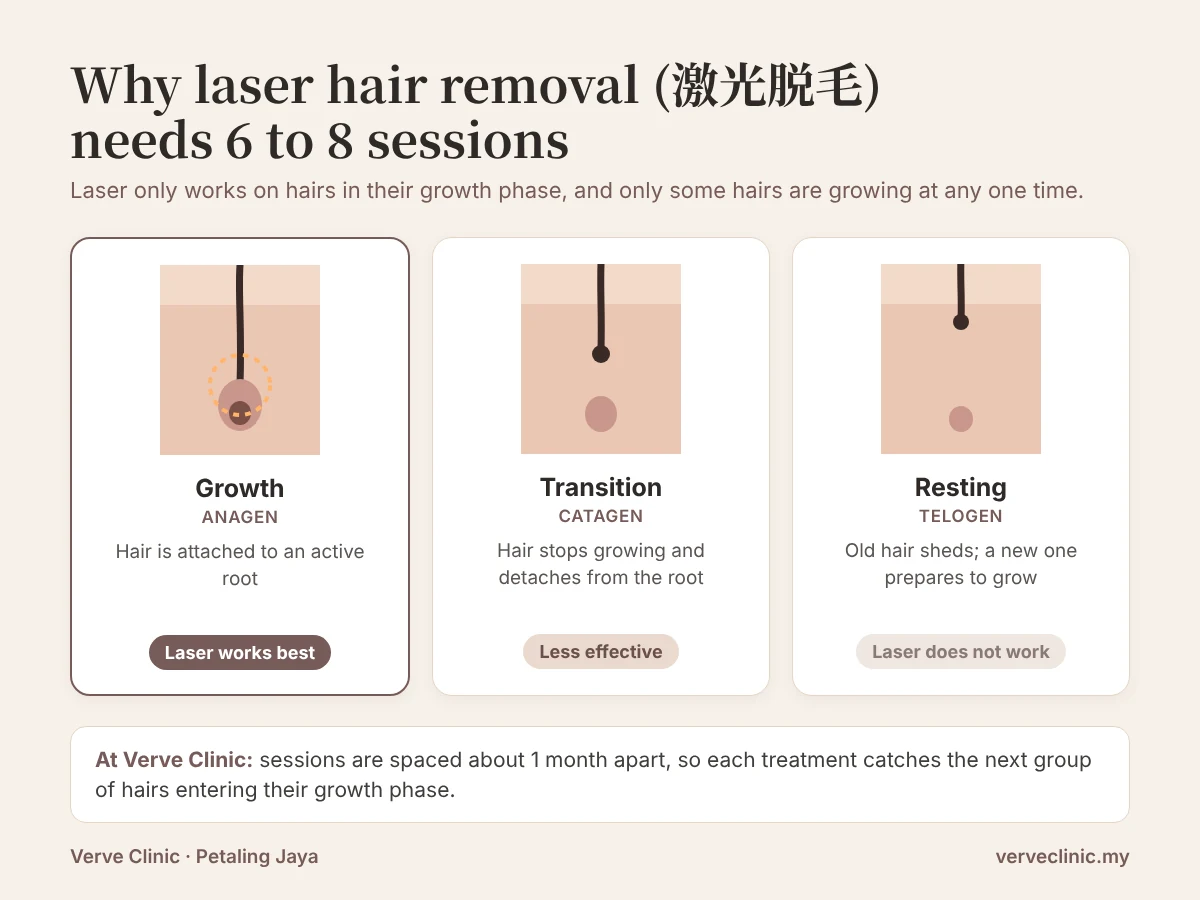
This is why we space sessions about 1 month apart, and why most people need 6 to 8 sessions to treat every hair as it enters its growth phase.
Why does the type of laser matter for Asian and tanned skin?
Laser hair removal works by targeting pigment. The challenge in darker or tanned skin is that the skin itself also contains more pigment, which can absorb the laser energy and cause burns or dark marks if the wrong laser is used.
The Fotona long-pulsed Nd:YAG laser uses a longer wavelength (1,064 nm) that passes the pigment in the skin surface and reaches deeper into the follicle. The Endocrine Society’s clinical guideline recommends long-wavelength lasers, such as Nd:YAG or diode lasers, for women with darker skin. This is why the Fotona Nd:YAG laser suits all skin types, including tanned skin, for both men and women.
In the Lasers in Medical Science study of 150 patients with darker skin, 86% had no side effects at all, and every side effect that did occur was temporary.
Laser hair removal vs IPL, waxing and shaving
Laser hair removal is the only option here that gives permanent hair reduction. Shaving, waxing and creams remove hair temporarily, while IPL also targets the root but is generally less effective, especially on darker skin.
| Laser hair removal (Nd:YAG) | IPL | Waxing | Shaving | |
|---|---|---|---|---|
| How it works | Laser heats and disables the root | Broad-spectrum light heats the root | Pulls hair out from the root | Cuts hair at the surface |
| How long results last | Permanent hair reduction | Long-term reduction, usually less than laser | 3 to 6 weeks | 1 to 3 days |
| Ingrown hairs and bumps | Reduced | Reduced | Common | Common |
| Underarm darkening | Often improves | May improve | Can worsen with repeated irritation | Can worsen with repeated irritation |
| Suits darker skin | Yes | Less suitable | Yes | Yes |
In the randomised trial comparing the two in women with darker skin, the Nd:YAG laser reduced underarm hair by 79.4%, compared with 54.4% for IPL. Although the laser was slightly more uncomfortable, 74% of the women preferred it.
More than smooth skin: fewer bumps and brighter underarms
Laser hair removal does more than reduce hair. Because you no longer need to shave or wax as often, it also helps with the problems that hair removal causes:
- Folliculitis and ingrown hairs. Shaving and waxing can inflame the hair follicles and trap hairs under the skin. With less hair, these bumps become less common.
- Razor bumps. In a study in Dermatologic Surgery, a 1,064 nm laser reduced razor bumps (pseudofolliculitis barbae) by 91.2% and the dark marks they leave by 59.5%.
- Darker underarms and bikini line. Repeated shaving, waxing and ingrown hairs can leave the skin darker. As the irritation settles, many patients find the treated area looks smoother and brighter.
If your underarms also sweat heavily, our guide to hyperhidrosis treatment explains how sweat-blocking injections can help.
Which areas can be treated?
At Verve Clinic, we offer laser hair removal for women and men, on most areas of the face and body:
| Area | Common reasons |
|---|---|
| Face and upper lip | Fine facial hair, a cleaner upper lip |
| Underarms | Smoother skin, less irritation from shaving, brighter underarms |
| Arms and legs | Long-term reduction instead of regular waxing |
| Bikini line | Fewer ingrown hairs and bumps |
| Men’s beard line | Beard shaping, fewer razor bumps on the neck |
| Men’s chest, back and shoulders | Long-term reduction of thick body hair |
Could excess hair be a sign of a hormone problem?
Sometimes. Excess dark hair on the face, chest or abdomen in women, called hirsutism, can be a sign of a hormone imbalance. According to the Endocrine Society’s guideline, hirsutism affects 5% to 10% of women, and 70% to 80% of women with hirsutism have polycystic ovary syndrome (PCOS). The guideline recommends testing hormone levels in women with significant excess hair.
Laser hair removal treats the hair, but not the cause. If your hair growth is new, increasing or comes with irregular periods, acne or weight changes, we can check your hormones as part of our hormone care, so that both the cause and the hair are treated.
What happens during laser hair removal at Verve Clinic?
A laser hair removal session at Verve Clinic takes 45 minutes to 1.5 hours, depending on the size of the area. Most people go back to their normal routine straight after.
- Consultation. Your doctor checks your skin type, hair colour and medical history, and confirms that laser hair removal suits you.
- Preparation. You shave the area 3 to 4 days before your session, and avoid waxing or plucking for a few weeks beforehand.
- Treatment. The Fotona laser is passed over the area, with cooling throughout the treatment. Most people feel a quick, warm snap with each pulse.
- After treatment. Mild redness usually settles within a few hours. Avoid shaving, waxing and plucking between sessions, apart from shaving 3 to 4 days before your next session.
- Your next session. Sessions are spaced about 1 month apart, usually 6 to 8 in total.
| Laser hair removal quick facts | |
|---|---|
| Laser | Fotona long-pulsed Nd:YAG |
| Treatment time | 45 minutes to 1.5 hours, depending on the area |
| Usual course | 6 to 8 sessions, about 1 month apart |
| Comfort | A quick, warm snap; cooling throughout the treatment |
| Downtime | Mild redness for a few hours |
| Skin types | All skin types, including tanned skin |
| Hair colour | Works on dark hair; not on white, grey or fair hair |
| Results | Permanent hair reduction, with occasional top-ups |
Who is laser hair removal suitable for?
Laser hair removal suits men and women with dark hair who want long-term hair reduction, whatever their skin type. You may be a good candidate if you:
- are tired of shaving, waxing or plucking
- get ingrown hairs, razor bumps or folliculitis
- have darker underarms or bikini line from hair removal
- want smoother skin with less maintenance
We postpone treatment during pregnancy and on sunburnt or broken skin. Laser hair removal is not suitable for white, grey or fair hair, because there is not enough pigment for the laser to target.
Is laser hair removal at a beauty salon safe?
Laser hair removal is safest when it is planned by a doctor, with a genuine laser that suits your skin type. Since 1 June 2026, lasers used for hair removal, including Nd:YAG, diode and Alexandrite lasers, have been regulated as designated medical devices in Malaysia under the Medical Device (Designated Medical Device) Order 2026.
Before you book laser hair removal anywhere, ask:
- Which laser will be used, and does it suit my skin type?
- Is the device registered for use in Malaysia?
- Who will assess my skin and plan my treatment?
- What happens if I have a side effect, such as a burn or dark mark?
How much does laser hair removal cost in Malaysia?
The cost of laser hair removal in Malaysia depends on the areas treated, the number of sessions you need and the laser used. A small area such as the upper lip costs less per session than full legs or a man’s back. That is why we give a personalised quote after your consultation, rather than a one-size-fits-all package.
Be cautious of very cheap or unlimited packages. You cannot always be sure which device is used, whether it suits your skin type or who is responsible if something goes wrong.
Frequently asked questions
Is laser hair removal permanent?
Laser hair removal gives permanent hair reduction. After a full course, many patients are left with almost no visible hair, and any hair that grows back is usually finer and lighter. Occasional top-up sessions help keep the result.
How many laser hair removal sessions do I need?
Usually 6 to 8 sessions, about 1 month apart. Hair grows in cycles, and laser only affects hairs in their active growth phase, so several sessions are needed to treat every hair.
Does laser hair removal hurt?
Most people feel a quick, warm snap with each pulse. Cooling is used throughout the treatment to keep the skin comfortable.
Is laser hair removal safe for tanned or darker skin?
Yes, with the right laser. The Fotona long-pulsed Nd:YAG laser uses a longer wavelength that passes the pigment in the skin surface and targets the hair root, which is why it suits all skin types, including tanned skin.
Does laser hair removal work on white, grey or fair hair?
No. Laser targets the pigment in the hair, so white, grey and fair hair do not respond. Dark hair responds best.
Is there any downtime?
Very little. Mild redness usually settles within a few hours, and you can return to normal activities the same day.
How long does a session take?
Between 45 minutes and 1.5 hours, depending on the size of the area treated.
How should I prepare for laser hair removal?
Shave the area 3 to 4 days before your session, and avoid waxing or plucking for a few weeks beforehand, because laser needs the hair root to be present.
Can I shave between sessions?
No. Please avoid shaving, waxing, plucking and epilators between sessions. The only exception is shaving the area 3 to 4 days before your next session, as part of your preparation.
Can laser hair removal help ingrown hairs and bumps?
Yes. By reducing hair, laser hair removal helps prevent folliculitis, ingrown hairs and razor bumps. In one study, a 1,064 nm laser reduced razor bumps by 91.2%.
Will laser hair removal lighten dark underarms?
It can help. Dark underarms are often made worse by shaving, waxing and ingrown hairs. With less hair removal irritation, many patients find the treated area looks smoother and brighter.
Is laser hair removal better than IPL?
For darker skin, a long-pulsed Nd:YAG laser is generally more effective. In one randomised trial in women with darker skin, it reduced underarm hair by 79.4%, compared with 54.4% for IPL.
Can men have laser hair removal?
Yes. We treat men’s beard line, chest, back and shoulders, as well as other areas.
What are the side effects of laser hair removal?
Most people have only mild redness for a few hours. Temporary darkening or lightening of the skin can occur but is uncommon; in a study of 150 patients with darker skin, 86% had no side effects at all, and every side effect was temporary. Choosing the right laser for your skin type lowers the risk.
Who should not have laser hair removal?
We postpone treatment during pregnancy and on sunburnt or broken skin. It is also not suitable for white, grey or fair hair.
Could excess hair be a sign of a hormone problem?
Sometimes. Excess facial or body hair in women can be linked to polycystic ovary syndrome (PCOS) or other hormone imbalances. We can check for this as part of our hormone care.
What is 激光脱毛 or buang bulu laser?
Both mean laser hair removal. 激光脱毛 is the Chinese term, and buang bulu laser is the Malay term.
How much does laser hair removal cost in Malaysia?
It depends on the areas treated and the number of sessions you need. WhatsApp us for a personalised quote.
Ready to stop shaving and waxing?
At Verve Clinic in Petaling Jaya, which welcomes patients from Kuala Lumpur, PJ and across the Klang Valley, a doctor will check your skin and hair, explain whether laser hair removal is right for you and plan a course that suits your skin type. You can read more about our Fotona laser hair removal, or WhatsApp us to arrange your consultation and a personalised quote.
About the author
Dr. Adriene Chee is the Medical Director of Verve Clinic in Petaling Jaya. She has more than 10 years of experience, and the clinic has offered Fotona laser treatments since 2022. Her qualifications include an MD from the National University of Malaysia (UKM), a Postgraduate Diploma in Dermatology (Bangkok) and an LCP in Aesthetic Medicine. Meet our team.
This article is general information, not medical advice. Results vary from person to person. Please discuss the benefits and risks of any treatment with a qualified doctor.