Hyaluronic acid filler (玻尿酸) or a collagen stimulator like AestheFill (艾丽斯精灵针)? How each works, what results to expect, and why many faces do best with both
Medically reviewed by Dr. Adriene Chee, Medical Director, Verve Clinic. Last updated: October 2026.
You notice it in photos first. Your temples look a little hollow, your cheeks sit flatter than before, and the lines from your nose to your mouth seem deeper. Friends ask if you are tired. You know an injectable could help, but which one? Filler? Something that “builds collagen”? And will you still look like yourself?
The answer depends on what has changed in your face and what kind of result you want. In this guide, Dr. Adriene Chee, who has been practising since 2015, explains the difference in plain terms, so you can walk into your consultation knowing what to ask.
Dermal fillers vs collagen biostimulators: what is the difference?
In short: A hyaluronic acid (HA) filler adds volume straight away and lasts about 6 to 18 months. A collagen biostimulator such as AestheFill prompts your skin to make its own collagen, so results build over 2 to 3 months and usually last 18 to 24 months. Filler suits precise shape; AestheFill suits natural, overall renewal.
Think of it this way. Filler is like placing a cushion exactly where support is missing: you see the shape immediately. AestheFill is like putting up scaffolding and letting your body build the support itself: it takes a few weeks, but what grows is your own tissue.
What is a hyaluronic acid filler (玻尿酸)?
Hyaluronic acid is a sugar molecule your skin already makes. It holds water and keeps skin plump. An HA filler is a smooth gel of this molecule, which the doctor injects into specific points to restore lost volume or add shape.
- Results are immediate: you see the change as soon as the treatment is done.
- It is precise: ideal for shaping the nose, chin, lips and jawline, or filling a defined hollow.
- It lasts about 6 to 18 months: lips tend to be at the shorter end; deeper areas such as the chin, nose and cheeks last longer.
- It can be reversed: if needed, HA filler can be dissolved with an enzyme called hyaluronidase. At Verve Clinic, hyaluronidase is always kept on hand.
HA filler is one of the most popular aesthetic treatments in the world. According to the International Society of Aesthetic Plastic Surgery (ISAPS) 2024 global survey, HA filler procedures rose by 5.2% to 6.3 million, making filler the second most common non-surgical treatment worldwide.
How long HA filler lasts depends on the area treated:
| Area | How long HA filler usually lasts |
|---|---|
| Lips | About 6 to 9 months |
| Tear troughs (under-eye hollows) | About 6 to 9 months |
| Nose, chin and cheeks | About 12 to 18 months |
What is a collagen biostimulator like AestheFill (艾丽斯精灵针)?
A collagen biostimulator does not work by filling space. It works by prompting your own cells to make new collagen. The aim is firmer, younger-looking skin rather than a different face.
AestheFill is made of poly-D,L-lactic acid (PDLLA), a material that dissolves naturally in the body. It comes as tiny, porous microspheres. Once injected, these microspheres act as a scaffold: your skin’s collagen-making cells move in and lay down new collagen around them, and inside their pores. As the microspheres slowly dissolve, your own collagen remains.
- Results build gradually: some fullness is visible on the day but settles within a week. The real result appears over 6 to 8 weeks and keeps improving for about 3 months.
- It looks natural: because the change comes from your own collagen, the face looks fresher and firmer, not “done”.
- It lasts longer: results usually last 18 to 24 months.
- It improves the skin itself: as well as gentle volume, many patients notice firmer, thicker skin.
Dermal filler vs AestheFill: side-by-side comparison
Here is how the two treatments compare side by side:
| Hyaluronic acid filler (玻尿酸) | AestheFill (艾丽斯精灵针) | |
|---|---|---|
| How it works | A gel adds volume where it is placed | Microspheres stimulate your own collagen |
| When you see results | Straight away | Gradually, over 2 to 3 months |
| How long it lasts | About 6 to 18 months, depending on the area | Usually 18 to 24 months |
| Sessions | Usually one session per area, with top-ups as needed | Usually 1 to 2 sessions, 4 to 6 weeks apart |
| Downtime | Minimal; most patients go about their day straight away | Mild swelling, redness or small bruises for 1 to 3 days |
| Best for | Precise shape: nose, chin, lips, jawline, defined hollows | Broad, natural renewal: temples, flat cheeks, smile lines, overall ageing |
| Can it be dissolved? | Yes, with hyaluronidase | No |
| Effect on skin quality | Mainly volume and shape | Firmer, thicker skin as collagen builds |
Which works best for each area?
As a rule, HA filler is better where you need precise shape, such as the nose, chin and lips, while AestheFill is better for broad areas that have lost volume, such as the temples and cheeks. Many areas benefit from both. As a general guide:
| Area | Usually better with | Why |
|---|---|---|
| Nose and chin | HA filler | Gives precise, immediate projection and shape |
| Lips | HA filler | Adds shape and definition with fine control |
| Under-eye hollows (tear troughs) | HA filler or AestheFill | Filler gives an instant result; AestheFill gradually thickens thin skin. Your doctor will check which suits you |
| Temples and flat cheeks | AestheFill or HA filler | AestheFill for gradual, natural fullness; filler if you want the change straight away |
| Smile lines and marionette lines | Either, often both | Filler softens a deep fold immediately; AestheFill rebuilds support around it |
| Jawline | HA filler, AestheFill or both | Filler sharpens the edge; AestheFill firms the skin along the jaw |
| Overall tired, ageing face | AestheFill | Renews collagen across the face for a fresher look |
Why many faces do best with both
Ageing rarely happens in just one way. Most faces lose collagen across the whole face and lose structure at a few key points, such as the cheekbones, chin or jawline. That is why a combined plan often gives the most natural result:
- AestheFill first to rebuild collagen and restore gentle, even volume across the face.
- HA filler to fine-tune the points that need precise shape, such as the chin, jawline or lips.
- Maintenance with a top-up when the effect starts to fade, so you never have to start from scratch.
If sagging is the main concern rather than volume loss, injectables alone may not be enough. In that case, an Aptos thread lift can lift the jowls and cheeks, and HIFU or Matrix can tighten the skin. For skin texture and glow without added volume, a collagen skin booster such as Juvelook is the better fit.
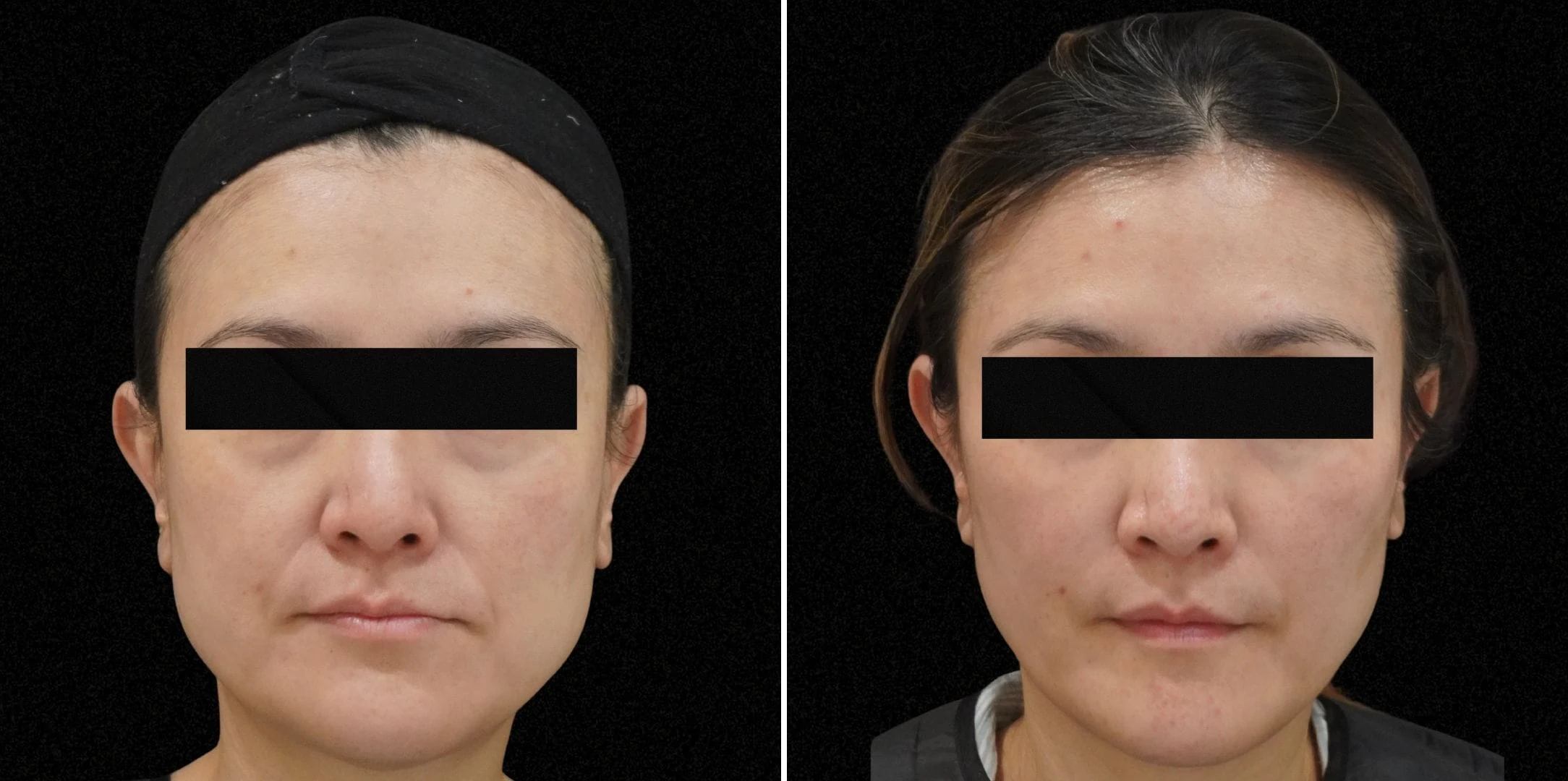
A real result: filler and AestheFill together
This patient had HA filler and AestheFill in the same session. The filler gives the immediate change you see here, 2 weeks after treatment; the AestheFill result keeps building over the following 2 to 3 months as new collagen forms.
What does the research say?
HA fillers have been used worldwide for many years, and their effect is well understood: the gel adds volume where it is placed, and the body gradually breaks it down. The U.S. Food and Drug Administration notes that how long a filler lasts depends on the filler material and the area where it is injected.
AestheFill was first approved in Korea in 2014. In a 2019 laboratory study published in Plastic and Aesthetic Research, new type I collagen formed between the PDLLA microspheres from week 4, and inside them by week 12, while the injected volume stayed stable to the end of the 20-week study. The microspheres stayed where they were injected and did not migrate.
A 2020 summary in the Journal of Cosmetic Dermatology reports that in a 24-month clinical study of smile lines, improvement peaked at around 6 months, with no serious side effects reported.
In our clinic, this matches what we see: filler gives an immediate, precise change, while AestheFill gives a softer improvement that keeps building for months and lasts longer.
AestheFill vs Sculptra: what is the difference?
AestheFill and Sculptra are both collagen biostimulators, but they are made of different materials and are not interchangeable. AestheFill contains poly-D,L-lactic acid (PDLLA) in round microspheres, while Sculptra contains poly-L-lactic acid (PLLA) in irregular, flake-like particles. Both work by prompting your skin to make new collagen over several weeks.
A 2025 laboratory study in the journal Polymers compared the two under the microscope. AestheFill’s particles were mostly round and averaged about 25 micrometres, while Sculptra’s were sheet-like and about twice the size, averaging about 50 micrometres. The authors concluded that these fillers are “not interchangeable in practice”.
| AestheFill | Sculptra | |
|---|---|---|
| Material | Poly-D,L-lactic acid (PDLLA) | Poly-L-lactic acid (PLLA) |
| Particle shape | Round microspheres | Irregular, flake-like particles |
| Average particle size | About 25 micrometres | About 50 micrometres |
| Where it is used | Full face, neck and selected body areas at Verve Clinic | Approved in the US for facial wrinkles and folds, such as smile lines and cheek wrinkles |
| Typical sessions | Usually 1 to 2 at Verve Clinic, 4 to 6 weeks apart | Commonly 2 to 3, 4 to 6 weeks apart |
AestheFill is also more versatile in how it can be used. At Verve Clinic, we use it across the full face, the neck and selected areas of the body, while Sculptra’s approved uses in the US focus on facial wrinkles and folds, such as smile lines and cheek wrinkles.
Are fillers and biostimulators safe?
Both HA filler and AestheFill are low-risk treatments when performed by a trained doctor. Most side effects are mild and settle within a few days. What you may notice:
- swelling, redness or tenderness at the injection points
- small bruises, which can be covered with makeup
- with AestheFill, small bumps under the skin are rare, because its round, evenly sized microspheres are designed to spread evenly
Like any injection, fillers carry a small risk of complications, the most important being filler entering a blood vessel. This is rare, and it is why injectables should only be done by a doctor with a detailed knowledge of facial anatomy.
At Verve Clinic, all filler and AestheFill treatments are performed by a doctor, and hyaluronidase is always kept on hand so HA filler can be dissolved quickly if needed.
Treatment is postponed during pregnancy or breastfeeding, or if there is an infection or inflammation in the area. If you have an autoimmune condition or form raised scars easily, please discuss this with your doctor first.
What happens at your appointment?
Every treatment starts with a consultation. Your doctor looks at where your face has lost volume or structure, talks through your goals, and recommends filler, AestheFill or a combination.
| Quick facts | HA filler | AestheFill |
|---|---|---|
| Comfort | Numbing cream; most fillers also contain a local anaesthetic | Numbing cream before treatment |
| Downtime | Minimal | 1 to 3 days of mild swelling or bruising |
| When you see a change | Straight away | Over 6 to 8 weeks, improving for about 3 months |
| How long it lasts | About 6 to 18 months, depending on the area | Usually 18 to 24 months |
| Sessions | Usually one, with top-ups as needed | Usually 1 to 2, 4 to 6 weeks apart |
Filler or collagen biostimulator: which is better for you?
HA filler may suit you if you:
- want to see a change straight away, for example before an event
- want precise shape in a specific area, such as the nose, chin or lips
- like knowing the result can be adjusted or dissolved
AestheFill may suit you if you:
- want a gradual change that people notice as “you look well”, not “you had something done”
- have hollow temples, flatter cheeks or an overall tired look
- want results that last longer, with fewer treatments
A combination may suit you if you have both overall volume loss and specific areas that need shape. This is the most common situation we see.
A note from Dr. Adriene Chee: “Patients often ask me which is better, filler or AestheFill. The honest answer is that they do different jobs. Filler gives shape where you need it; AestheFill rebuilds what time has taken away. When we use each for what it does best, the result looks like a fresher version of you.”
Frequently asked questions
What is the difference between dermal fillers and collagen biostimulators?
A hyaluronic acid (HA) filler adds volume straight away by placing a gel under the skin. A collagen biostimulator such as AestheFill adds little volume on the day; instead, it prompts your skin to make new collagen, so fullness and firmness build gradually over 2 to 3 months.
Is AestheFill a filler?
Not in the usual sense. AestheFill is often grouped with fillers because it is injected, but it is a collagen biostimulator. Instead of adding volume with a gel, it prompts your skin to make new collagen, so the result builds gradually over 2 to 3 months.
Which lasts longer, filler or AestheFill?
AestheFill usually lasts longer. HA filler lasts about 6 to 18 months depending on the area, while results from AestheFill usually last 18 to 24 months.
Is AestheFill permanent?
No. The AestheFill microspheres are gradually absorbed by the body, and results usually last 18 to 24 months. A top-up session when the effect starts to fade helps maintain the result.
Which gives faster results?
HA filler. You see the change as soon as you leave the clinic. AestheFill works gradually, with the real result appearing over 6 to 8 weeks and improving for about 3 months.
Can filler be reversed?
Yes. HA filler can be dissolved with an enzyme called hyaluronidase if needed. At Verve Clinic, hyaluronidase is always kept on hand. AestheFill cannot be dissolved, which is why careful planning and technique matter.
Can I have filler and AestheFill together?
Yes, and many patients do. AestheFill improves overall collagen and gentle volume, while filler adds precise shape where you need it, such as the chin, nose or lips. Your doctor will plan the order and timing.
Can I have AestheFill if I already have filler?
Yes. AestheFill and HA filler can be combined, sometimes in the same session, as with the patient shown above. Your doctor will check your existing filler and plan the order and timing.
What is the difference between AestheFill and Sculptra?
Both are collagen biostimulators. AestheFill is made of poly-D,L-lactic acid (PDLLA) in round microspheres, while Sculptra is made of poly-L-lactic acid (PLLA) in irregular, flake-like particles. A 2025 laboratory study concluded that the two are not interchangeable. At Verve Clinic, AestheFill is used on the full face, the neck and selected areas of the body.
Will I look overfilled or puffy?
Not when the treatment is planned well. With filler, the amount and placement are tailored to your face. With AestheFill, the change comes from your own collagen and builds slowly, so it tends to look natural.
How many AestheFill sessions will I need?
Usually 1 to 2 sessions, 4 to 6 weeks apart. Your doctor will advise based on how much volume and collagen you have lost.
Is there downtime?
HA filler has minimal downtime, and most patients go about their day straight away. AestheFill may cause mild swelling, redness or small bruises for 1 to 3 days, and most patients return to work the next day.
Which is better for the nose and chin?
HA filler. It gives precise, immediate projection. AestheFill is better for broader areas such as hollow temples, flat cheeks and an overall tired look.
Is filler or AestheFill better for under-eye hollows?
Both can work, depending on how thin the skin is and how deep the hollow is. HA filler gives an immediate result, while AestheFill gradually thickens the skin. Your doctor will check which suits you.
Who should not have filler or AestheFill?
Treatment is postponed during pregnancy or breastfeeding, or if there is an infection or inflammation in the area. If you have an autoimmune condition or form raised scars easily, discuss this with your doctor first.
How much do fillers or AestheFill cost?
It depends on the areas treated and how much product you need, so we give a personalised quote after your assessment. WhatsApp us for a quote.
Not sure which one you need? Start with a facial assessment
The best treatment is the one planned for your face. At Verve Clinic in Petaling Jaya, a doctor will assess your face, explain your options and build a plan with filler, AestheFill or both. WhatsApp us to arrange your assessment, or read more about our dermal filler and AestheFill treatments.
About the author
Dr. Adriene Chee is the Medical Director of Verve Clinic in Petaling Jaya. She has been practising since 2015. Her qualifications include an MD from the National University of Malaysia (UKM), a Postgraduate Diploma in Dermatology (Bangkok) and an LCP in Aesthetic Medicine. Meet our team.
This article is general information, not medical advice. Results vary from person to person. Please discuss the benefits and risks of any treatment with a qualified doctor.