Always told you look tired, even after a full night’s sleep? What really causes eye bags (眼袋, kantung mata) and dark circles (黑眼圈, mata panda), how to tell which one you have, which treatments help each type, and what results are realistic.
Medically reviewed by Dr. Adriene Chee, Medical Director, Verve Clinic. Last updated: 6 November 2026.
You sleep eight hours, drink your water and still get asked if you are tired. Concealer creases by lunchtime, and photos taken in overhead light show every shadow. Eye bags and dark circles are among the most common concerns we see, and also among the most misunderstood, because they are rarely caused by lack of sleep alone.
In this guide, Dr. Adriene Chee, a doctor with more than 10 years of experience, explains the different causes of these under-eye concerns, how to tell which one you have, and why the right treatment depends on what is happening under your skin.
What causes eye bags and dark circles?
In short: Eye bags (眼袋, kantung mata) are puffiness or a bulge under the eye from fat, fluid or loose skin. Dark circles (黑眼圈, mata panda) are a colour change or shadow from pigment, blood vessels or a hollow. Many people have both. Treatment works best when matched to the cause, and both usually improve, though rarely disappear completely.
The skin under the eyes is among the thinnest on the body, so anything beneath it, such as blood vessels, fat or a hollow, shows through easily. With age, the supporting tissue weakens, fat shifts and the skin loses collagen, which is why under-eye concerns often become more noticeable from our thirties onwards. Genetics plays a big part too, which is why some people have them even in their teens.
They are also common in Malaysia. In a study of 100 Malaysian patients in Skin Research and Technology, vascular dark circles, caused by visible blood vessels, were the most common type at 51%, while purely pigmented ones were the least common at 6%. This matters, because a brightening cream cannot fix a dark circle that is caused by blood vessels or a hollow.
Eye bags or dark circles? 5 types and how to tell them apart
Most people have more than one type. A few simple checks in front of a mirror can give you a clue, but a doctor’s assessment is the most reliable way to know.
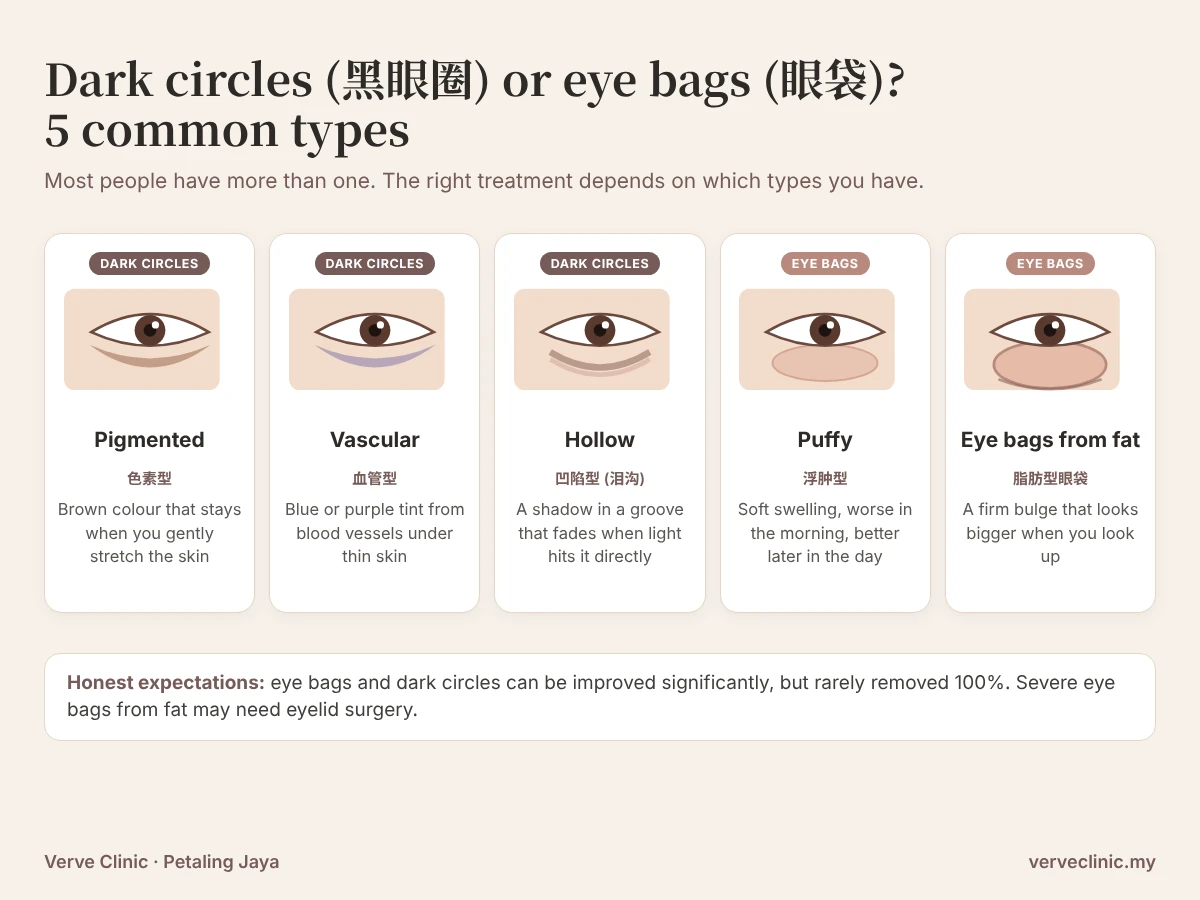
| Type | What it looks like | Quick check | Common causes |
|---|---|---|---|
| Pigmented dark circles | Brown or greyish-brown colour | Gently stretch the skin: the colour stays | Genetics, sun exposure, rubbing the eyes, eczema |
| Vascular dark circles | Blue, purple or reddish tint | Gently stretch the skin: the colour fades or turns bluer | Thin skin showing blood vessels, allergies, lack of sleep |
| Hollows (tear trough) | A dark shadow in a groove under the eye | The shadow fades when light shines straight at your face | Bone structure, volume loss with age |
| Puffiness | Soft swelling, often worse in the morning | Improves as the day goes on | Fluid retention, salty food, allergies, poor sleep |
| Eye bags from fat | A firm bulge under the lower lid | The bulge looks bigger when you look up | Fat pushing forward as supporting tissue weakens with age, genetics |
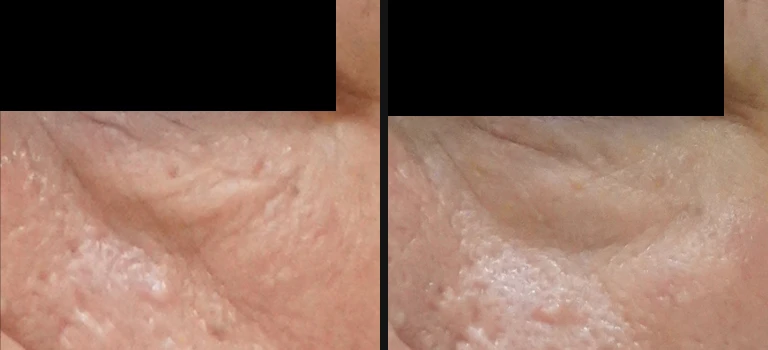
Eye bag and dark circle treatment before and after
These are real patients treated at Verve Clinic. Eyes are covered for privacy. Results vary from person to person.


Treatment options for eye bags and dark circles
Because everyone’s under-eye anatomy is different, there is no single treatment that suits everyone. Your doctor will first work out what is causing your under-eye concern, then choose the treatment, or combination, that suits you. These are the options we use, and the concerns each one helps:
| Concern | Treatment options | How they help |
|---|---|---|
| Pigmented dark circles | PicoWay laser, under-eye Skin boosters | PicoWay breaks up excess pigment so the brown colour fades, while Skin boosters improve skin quality and brightness |
| Vascular dark circles and thin skin | Under-eye Skin boosters, a collagen gel, Matrix RF microneedling | Thicken and strengthen the skin so blood vessels show through less |
| Hollows and tear troughs | Under-eye filler, a collagen biostimulator or a collagen gel | Restore lost volume and support the skin so the shadow softens |
| Puffiness and mild eye bags | Fotona SmoothEye laser, HIFU for the eye area, Matrix RF microneedling, a collagen biostimulator, a collagen gel | Tighten the skin and smooth the transition between the eye bag and the cheek |
| Severe eye bags from fat | Eyelid surgery (blepharoplasty) | Removes or repositions the fat; we refer you to a surgeon if this is the better option |
Most people see results within about 2 to 4 weeks, depending on the treatment. Downtime is usually minimal: some treatments cause very mild bruising or swelling, and some have none at all. The number of sessions, and how long results last, depend on the treatment and on the cause of your concern.
If thin skin is your main concern, our article on collagen gel for dark circles explains one of these options in more detail.
Is under-eye filler right for you?
Under-eye filler can work well for hollows and tear troughs, but it is not suitable for everyone. We do not recommend it for people with puffy eyes, eye bags or a tendency to fluid retention, because filler attracts water and can make puffiness worse.
Technique matters too. According to the American Academy of Ophthalmology’s EyeWiki, filler placed too close to the surface can cause a bluish tint (the Tyndall effect), and swelling below the eye has been reported in up to 11% of tear trough filler treatments. Careful assessment, the right product, a measured amount and deep placement lower these risks. Our article on overfilled face syndrome explains why less is often more.
When eye bags need surgery
Non-surgical treatments can improve mild to moderate eye bags by tightening the skin and smoothing the area around them. But when they are caused by a large amount of fat pushing forward, non-surgical treatment can only improve them so far.
In these cases, eyelid surgery (lower blepharoplasty) may give a better result. We will tell you honestly if this is the case, and refer you to a surgeon rather than recommend treatments that cannot give you the result you want.
What results can you expect?
A note from Dr. Adriene Chee: “With the right treatment, most eye bags and dark circles improve noticeably, and many of my patients are pleased with how much brighter and more rested they look. What I always explain, though, is that they rarely disappear completely. Genetics, bone structure, thin skin and natural ageing all play a part, and these continue over time. So the goal is not a perfect under-eye, but one that looks fresher, smoother and less tired, while you still look like yourself.”
| Eye bag and dark circle treatment quick facts | |
|---|---|
| First step | Assessment to find the cause: pigment, blood vessels, hollows, puffiness or fat |
| Treatment | Chosen for your anatomy and concern; often a combination |
| Results appear | Generally within 2 to 4 weeks, depending on the treatment |
| Downtime | Very minimal bruising or swelling; some treatments have none |
| Sessions | Depend on the treatment and the cause |
| Realistic goal | A noticeably brighter, fresher and more rested look; most people see good improvement, though they rarely disappear completely |
| Severe eye bags from fat | Referral for eyelid surgery when it is the better option |
Habits that help your under-eye area
Treatment works best alongside good daily habits:
- Protect from the sun. Use sunscreen and sunglasses, because UV darkens pigment and breaks down collagen.
- Stop rubbing. Rubbing itchy or tired eyes darkens the skin over time. If allergies make your eyes itchy, have them treated.
- Sleep and salt. Poor sleep and salty meals make puffiness worse, especially in the morning.
- Be gentle. Use a mild eye cream and remove make-up gently, without pulling the delicate skin.
How much does eye bag and dark circle treatment cost in Malaysia?
The cost depends on the cause of your under-eye concern and the treatments you need. A pigment concern may need only a few laser sessions, while hollows or loose skin may need a different approach. That is why we give a personalised quote after your consultation, rather than a one-size-fits-all package.
Frequently asked questions
What is the difference between eye bags and dark circles?
Eye bags are puffiness or a bulge under the eye, caused by fat pushing forward, fluid or loose skin. Dark circles are a change in colour or a shadow, caused by pigment, visible blood vessels or a hollow under the eye. Many people have both.
Can eye bags and dark circles be removed completely?
Most people see a clear improvement, with an under-eye area that looks brighter, smoother and more rested. They rarely disappear completely, because genetics, bone structure, thin skin and ageing all play a part and continue over time. The aim of treatment is a fresher, less tired look that still looks like you.
What causes dark circles?
Dark circles can be caused by extra pigment (brown), visible blood vessels under thin skin (blue or purple), a hollow that casts a shadow, or a mix of these. Genetics, ageing, lack of sleep, allergies and rubbing the eyes can make them worse.
What causes eye bags?
Eye bags are usually caused by the fat around the eye pushing forward as the supporting tissue weakens with age, by fluid retention or by loose skin. Genetics plays a big part, which is why some people have eye bags even when they are young.
Do eye creams work for dark circles?
Eye creams can help mild pigment and hydration, but they cannot fill a hollow, remove fat or strengthen thin skin significantly. Most people need in-clinic treatment for a visible improvement.
Is under-eye filler safe?
In the right patient and in experienced hands, yes. It is not suitable for everyone: we do not recommend it for people with puffy eyes, eye bags or fluid retention, because filler can make puffiness worse. Placing filler too close to the surface can also cause a bluish tint.
Can eye bags be treated without surgery?
Mild to moderate cases can often be improved without surgery, by tightening the skin and smoothing the area around them. More severe cases, where fat is pushing forward, may need eyelid surgery, and we will refer you to a surgeon if this is the better option.
When will I see results?
It depends on the treatment, but most people see results within about 2 to 4 weeks.
Is there any downtime?
Usually very little. Some treatments cause minimal bruising or swelling, and some have no downtime at all.
How many sessions will I need?
It depends on the cause and the treatment chosen. Your doctor will recommend a plan after assessing your under-eye area.
How long do the results last?
It depends on the treatment and the number of sessions. Because ageing continues, most people benefit from occasional maintenance.
Why do I have dark circles even when I sleep well?
Because most are not caused by tiredness. Thin skin that shows blood vessels, a hollow under the eye or pigment are usually inherited or related to ageing, and do not go away with sleep alone.
What are 眼袋, 黑眼圈, mata panda and kantung mata?
眼袋 means eye bags and 黑眼圈 means dark circles in Chinese. In Malay, kantung mata means eye bags and mata panda is a common term for dark circles.
How much does eye bag and dark circle treatment cost in Malaysia?
It depends on the cause and the treatments you need. WhatsApp us for a personalised quote after your consultation.
Ready to look less tired?
If you are looking for eye bag or dark circle treatment in Petaling Jaya, Verve Clinic welcomes patients from Kuala Lumpur, PJ and across the Klang Valley. A doctor will assess what is causing your under-eye concern, explain your options honestly and plan a treatment that suits your anatomy. WhatsApp us to arrange your consultation and a personalised quote.
About the author
Dr. Adriene Chee is the Medical Director of Verve Clinic in Petaling Jaya. She has more than 10 years of experience. Her qualifications include an MD from the National University of Malaysia (UKM), a Postgraduate Diploma in Dermatology (Bangkok) and an LCP in Aesthetic Medicine. Meet our team.
This article is general information, not medical advice. Results vary from person to person. Please discuss the benefits and risks of any treatment with a qualified doctor.