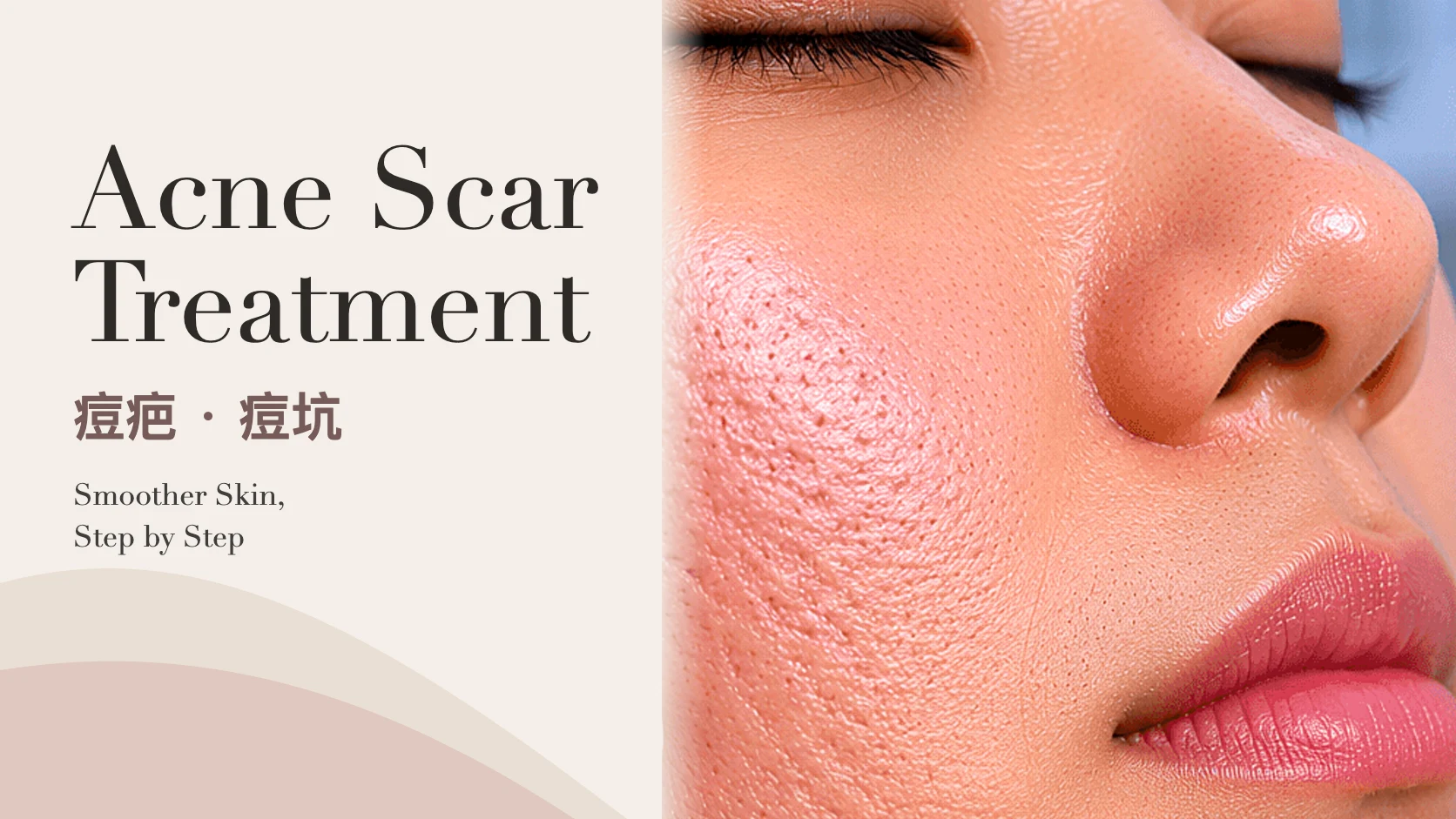
Pits, dents or uneven skin that stayed after your acne cleared? What causes acne scars (痘疤, 痘坑, parut jerawat), how to tell which type you have, which acne scar treatments work for each, and what results to expect
Medically reviewed by Dr. Adriene Chee, Medical Director, Verve Clinic. Last updated: 5 November 2026.
Your acne has finally settled, but the skin it left behind has not. Make-up sits in the dents, side lighting shows every pit, and close-up photos are something you avoid. Acne scars can feel permanent, and for a long time many people were told there was little to be done. That is no longer true. With the right combination of treatments, most acne scars can be improved significantly, and mild scars can sometimes be removed completely.
In this guide, Dr. Adriene Chee, a doctor with more than 10 years of experience, explains why acne scars form, the different types, which acne scar treatment suits each one, and why a planned combination usually works faster and better than a single treatment.
What are acne scars (痘疤)?
In short: Acne scars, also called pimple scars (痘疤 or 痘坑 in Chinese, parut jerawat in Malay), form when deep, inflamed acne damages the collagen in the skin. Most are pitted, a few are raised. Acne scar treatment rebuilds that collagen, usually by combining treatments matched to each type of scar, with sessions 1 to 2 months apart and results that build for up to a year.
When a pimple becomes deeply inflamed, the body rushes to repair the damage. If the repair produces too little collagen, the skin is left with a dent or pit (an atrophic scar). If it produces too much, the scar is raised (a hypertrophic scar or keloid). According to a review in the Journal of Drugs in Dermatology, 80% to 90% of people with acne scars have pitted scars, and raised scars are much less common.
Acne scars are also more common than many people think. In a study of 1,972 patients seeing dermatologists, 43% had acne scars, and most of them had only mild or moderate acne. The longer the delay before effective acne treatment, the higher the risk of scarring.
Acne scars or acne marks? Know the difference
Many people search for acne scar treatment when they actually have acne marks. The two look different and need different treatment:
| Acne marks (痘印) | Acne scars (痘疤, 痘坑) | |
|---|---|---|
| What you see | Flat brown or red spots where a pimple used to be | Dents, pits, wavy skin or raised bumps |
| Feel | Smooth, the same level as the skin around it | Uneven to the touch, below or above the skin surface |
| Cause | Leftover pigment (brown) or small blood vessels (red) after inflammation | Damage to the collagen deeper in the skin |
| Will it fade on its own? | Often improves slowly over months, but some may not fade completely without treatment | No, scars need treatment to improve |
| What helps | PicoWay laser, Fotona laser, peels and sun protection | Dedicated acne scar treatment, as below |
Brown marks are especially common in Asian skin. They are not true scars, but they can last for months, and some may not fade completely on their own. Laser treatment helps them fade faster and more fully.
Types of acne scars and how each is treated
There are four main types of acne scars. According to the same review, ice pick scars make up 60% to 70% of pitted scars, boxcar scars 20% to 30% and rolling scars 15% to 25%. Most people have a mix, which is why acne scar treatment is planned around the scars you actually have.
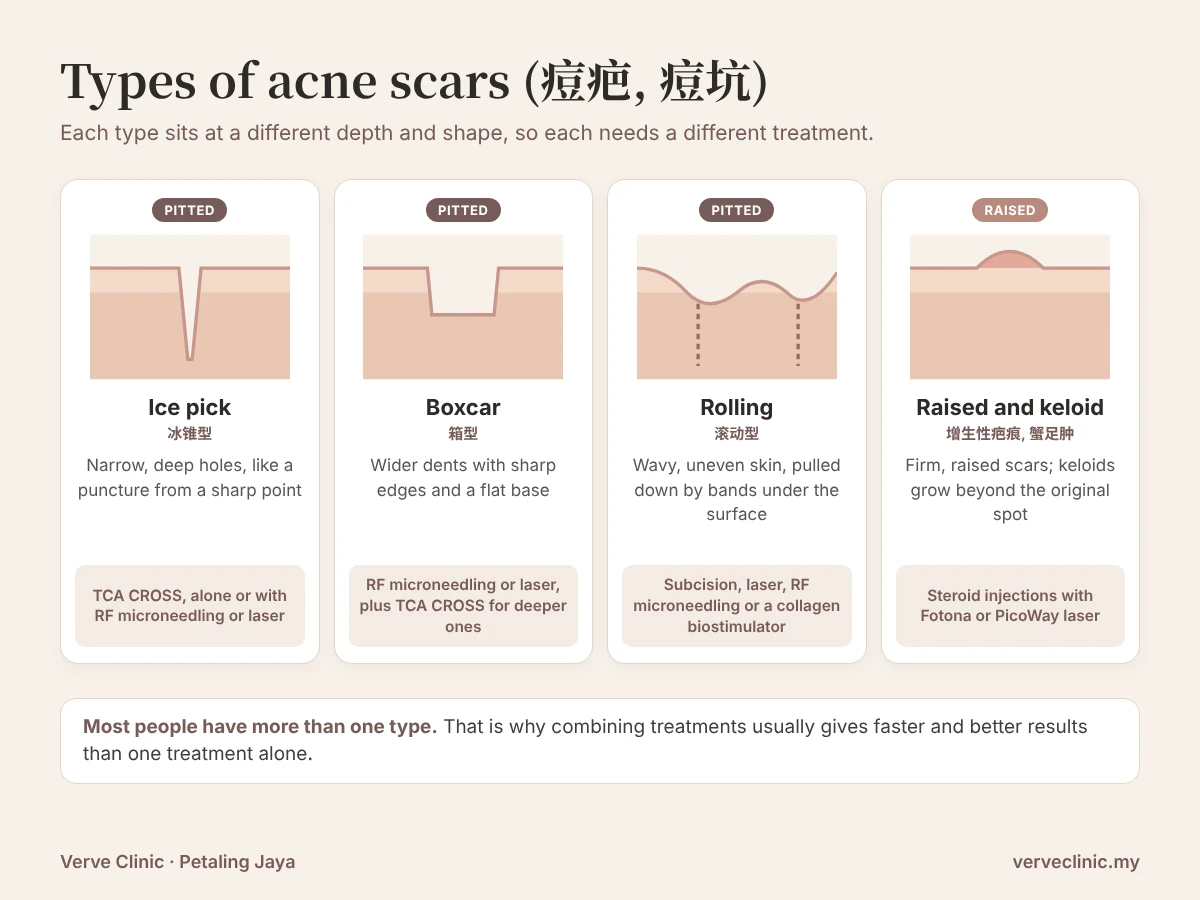
| Type of scar | What it looks like | Acne scar treatment that suits it |
|---|---|---|
| Ice pick (冰锥型) | Narrow, deep holes, like a puncture from a sharp point | TCA CROSS, often with RF microneedling or laser |
| Boxcar (箱型) | Wider, round or oval dents with sharp edges | RF microneedling or laser, plus TCA CROSS for deeper ones |
| Rolling (滚动型) | Wavy, uneven skin with soft edges, pulled down from underneath | Subcision, laser, RF microneedling or a collagen biostimulator |
| Raised and keloid (增生性疤痕, 蟹足肿) | Firm, raised scars; keloids grow beyond the original spot | Steroid injections, with Fotona or PicoWay laser |
Acne scar treatment before and after
This is a real patient treated at Verve Clinic. Results vary from person to person.
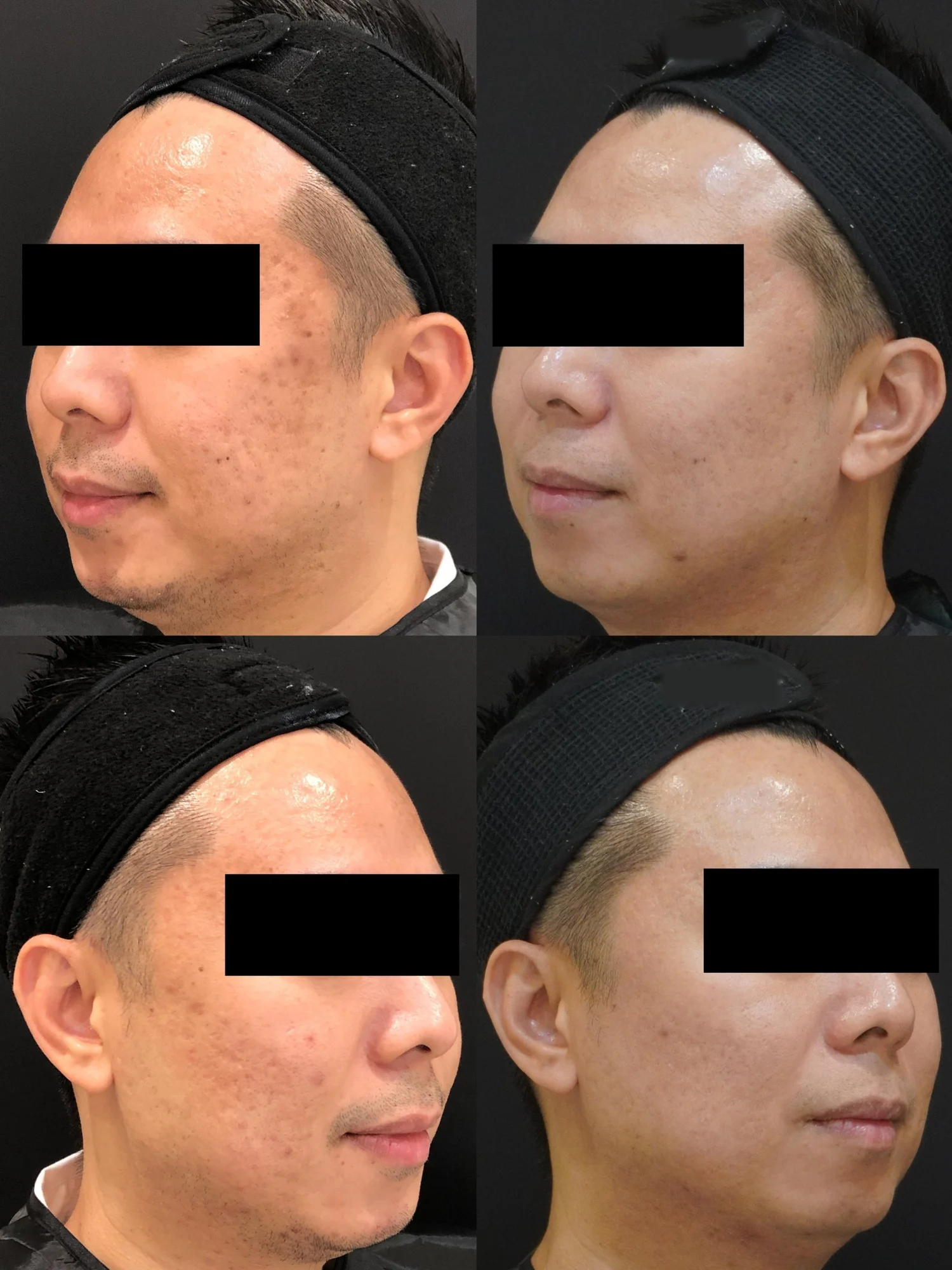
Acne scar treatments we use at Verve Clinic, from laser to TCA CROSS
Each acne scar treatment works in a different way and at a different depth of the skin. These are the treatments we use, and what each one does best.
TCA CROSS. A tiny amount of strong trichloroacetic acid (TCA) is placed deep into each ice pick scar. This triggers new collagen to fill the scar from the bottom up. In a study in the Journal of Cutaneous and Aesthetic Surgery, 8 of 10 patients with ice pick scars had more than 70% improvement after four sessions.
Subcision. Rolling scars are pulled down by tight bands of scar tissue under the skin. Subcision uses a fine needle to release these bands, so the skin can lift back up and new collagen can form underneath.
Matrix RF microneedling. Fine needles deliver radiofrequency energy into the deeper skin, stimulating new collagen to smooth boxcar and rolling scars while protecting the skin surface. Our article comparing Matrix and other RF microneedling explains how it works.
Dermapen microneedling. Controlled micro-injuries trigger the skin’s natural repair process, improving shallow scars and overall skin texture.
Fotona laser. The Er:YAG laser resurfaces the skin to soften the edges of scars, while the Nd:YAG laser works deeper to stimulate collagen and calm any remaining acne.
PicoWay laser. Very short laser pulses create tiny areas of renewal below the surface to improve texture, and break up the pigment of brown acne marks.
Collagen biostimulators and boosters. Injectable collagen biostimulators, a collagen booster and a collagen gel lift depressed scars from underneath and stimulate your own collagen over the following months. They work well for rolling scars and for scars that sit in areas of volume loss.
Supporting treatments. PRF (platelet-rich fibrin) and Skin boosters improve healing and skin quality, and are often added to a plan to support the main treatments.
Why combination acne scar treatment works better
Because most people have more than one type of scar, and each treatment works at a different depth, a single treatment rarely addresses everything. Combining treatments allows each scar to be treated with the method that suits it best.
This matters, because one treatment on its own often gives only a partial result. In a study of 26 Asian patients treated with fractional radiofrequency microneedling alone, the largest group reported a 26% to 50% improvement six months after three sessions. Combining treatments allows each type of scar to be targeted directly. Some of the combinations we use most often are:
| Combination | Why it works |
|---|---|
| RF microneedling with TCA CROSS | RF microneedling smooths boxcar and rolling scars, while TCA CROSS treats the deep ice pick scars |
| PicoWay laser with a collagen biostimulator | PicoWay refines texture and fades marks, while the biostimulator restores support under the scars |
| Laser with TCA CROSS | Laser resurfaces the overall texture, while TCA CROSS fills the narrow, deep scars |
| RF microneedling with a collagen biostimulator | RF microneedling remodels the scar, while the biostimulator lifts the depressed area from underneath |
Your plan may use different combinations, depending on your scars, your skin type and how much downtime you can take.
What results can you expect from acne scar treatment?
Honest expectations matter. Mild, shallow scars can sometimes be removed completely. Deeper or more widespread scars can be improved significantly, so they are much less noticeable, but usually not erased entirely.
- Sessions. Treatments are usually spaced 1 to 2 months apart. The number of sessions depends on the type and severity of your scars.
- First improvement. Most patients start to see improvement about a month after treatment, as new collagen forms.
- Full result. Collagen keeps rebuilding for months, so the full result of acne scar treatment can take up to a year.
- Downtime. Depending on the treatment, expect some redness and swelling, and with some treatments small scabs, for a few days.
A note from Dr. Adriene Chee: “Acne scar treatment needs patience. Collagen takes time to rebuild, so the full result can take up to a year. Combining treatments gives faster and better results than relying on one treatment alone.”
How we plan your acne scar treatment
- Assessment. Your doctor examines your scars in different lighting and angles, identifies each type and checks whether your acne is under control.
- Controlling active acne. Scar treatment can go alongside acne treatment, including isotretinoin, as long as your acne is well controlled. Our guide to acne treatment explains the options.
- Your treatment plan. We match a combination of treatments to your scar types, skin type and the downtime you can manage.
- Treatment sessions. Sessions are spaced 1 to 2 months apart, with numbing cream for comfort.
- Review. We review your progress and adjust the plan as your skin improves.
| Acne scar treatment quick facts | |
|---|---|
| Main treatments | Laser, RF microneedling, collagen biostimulators, subcision, TCA CROSS |
| Usual approach | A combination matched to your scar types |
| Session interval | 1 to 2 months apart |
| Number of sessions | Depends on the type and severity of your scars |
| First improvement | About a month after treatment |
| Full result | Up to a year |
| Downtime | Redness, swelling and sometimes small scabs for a few days, depending on the treatment |
| Comfort | Numbing cream for most treatments |
Is acne scar treatment safe for Asian skin?
Yes, when it is planned carefully. Asian skin is more prone to post-inflammatory hyperpigmentation, the dark marks that can appear after any treatment that causes inflammation. We lower this risk by choosing suitable treatments and settings, spacing sessions properly and advising on sun protection and skincare between sessions.
Treatments such as subcision, TCA CROSS and injectable collagen stimulators are medical procedures. In Malaysia, aesthetic procedures should be carried out by a registered doctor who holds a Letter of Credentialing and Privileging (LCP) from the Ministry of Health, at a licensed clinic.
How to prevent new acne scars
The best acne scar treatment is the scar you never get. If you still have breakouts:
- treat acne early and effectively, especially deep, painful spots
- do not pick, squeeze or pop pimples
- ask about an acne injection for large, painful spots, so they settle quickly
- protect your skin from the sun, so marks do not darken
Our guide to acne treatment in Petaling Jaya explains how we bring breakouts under control.
How much does acne scar treatment cost in Malaysia?
The cost of acne scar treatment in Malaysia depends on the type and severity of your scars, the treatments in your plan and the number of sessions you need. A few shallow scars need far less treatment than deep, widespread scarring. That is why we give a personalised quote after your consultation, rather than a one-size-fits-all package.
Frequently asked questions
Can acne scars be removed completely?
Mild, shallow acne scars can sometimes be removed completely. Deeper scars can be improved significantly, so they are much less noticeable, but they usually cannot be erased entirely.
How many sessions of acne scar treatment will I need?
It depends on the type and severity of your scars. Sessions are usually spaced 1 to 2 months apart, and deeper or more widespread scars need more sessions.
When will I see results?
Most patients start to see improvement about a month after treatment, as new collagen forms. The full result can take up to a year, because collagen keeps rebuilding for months after each session.
What is the best treatment for acne scars?
There is no single treatment that suits every scar. The right acne scar treatment depends on the type of scar, and most people have more than one type, so combining treatments usually gives faster and better results.
Is acne scar treatment painful?
Numbing cream is used for most treatments, so most patients feel only mild discomfort, such as warmth, pressure or a prickling sensation.
What is the downtime after acne scar treatment?
It depends on the treatment. Expect some redness and swelling, and with some treatments small scabs, for a few days. Your doctor will tell you what to expect before each session.
Can I treat acne scars while I still have acne?
Yes, as long as your acne is well controlled. We can treat scars alongside your acne treatment, but active, inflamed acne should be settled first.
Can I have acne scar treatment while on isotretinoin?
In our practice, yes, as long as your acne is well controlled. Your doctor will choose suitable treatments and settings for you.
What is the difference between acne scars and acne marks?
Acne marks are flat brown or red spots left after a pimple. They often fade with time, although some may not fade completely without treatment. Acne scars change the texture of the skin, leaving dents, pits or raised bumps, and need dedicated scar treatment.
What is TCA CROSS?
TCA CROSS places a tiny amount of strong acid deep into individual ice pick scars, which triggers new collagen to fill the scar from the bottom up.
What is subcision?
Subcision uses a fine needle under the skin to release the tight bands that pull rolling scars down, so the skin can lift back up.
Is acne scar treatment safe for Asian skin?
Yes, when the treatment and settings are chosen for your skin type. Asian skin is more prone to dark marks after treatment, so we adjust the plan and settings to lower this risk.
Can raised acne scars and keloids be treated?
Yes. Raised scars and keloids are usually treated with steroid injections to flatten them, combined with Fotona or PicoWay laser to improve their colour and texture.
Which laser is used for acne scars?
It depends on the scar. At Verve Clinic, Fotona laser resurfaces the skin to soften pitted scars and stimulate collagen, while PicoWay laser improves texture and fades brown acne marks. Laser is often combined with TCA CROSS, RF microneedling or a collagen biostimulator for better results.
Are pimple scars the same as acne scars?
Yes. Pimple scars is another name for acne scars: the dents, pits or raised bumps left after inflamed acne heals.
What are 痘疤, 痘坑, 痘印 and parut jerawat?
痘疤 and 痘坑 are Chinese terms for acne scars, especially pitted scars. 痘印 usually refers to acne marks. Parut jerawat is the Malay term for acne scars.
How much does acne scar treatment cost in Malaysia?
It depends on the type and severity of your scars and the treatments you need. WhatsApp us for a personalised quote after your consultation.
Ready for smoother skin?
If you are looking for acne scar treatment in Petaling Jaya, Verve Clinic welcomes patients from Kuala Lumpur, PJ and across the Klang Valley. A doctor will assess your scars, explain which types you have and plan a combination of treatments that suits your skin, with honest advice on the results to expect. WhatsApp us to arrange your consultation and a personalised quote.
About the author
Dr. Adriene Chee is the Medical Director of Verve Clinic in Petaling Jaya. She has more than 10 years of experience, including treating acne and acne scars. Her qualifications include an MD from the National University of Malaysia (UKM), a Postgraduate Diploma in Dermatology (Bangkok) and an LCP in Aesthetic Medicine. Meet our team.
This article is general information, not medical advice. Results vary from person to person. Please discuss the benefits and risks of any treatment with a qualified doctor.