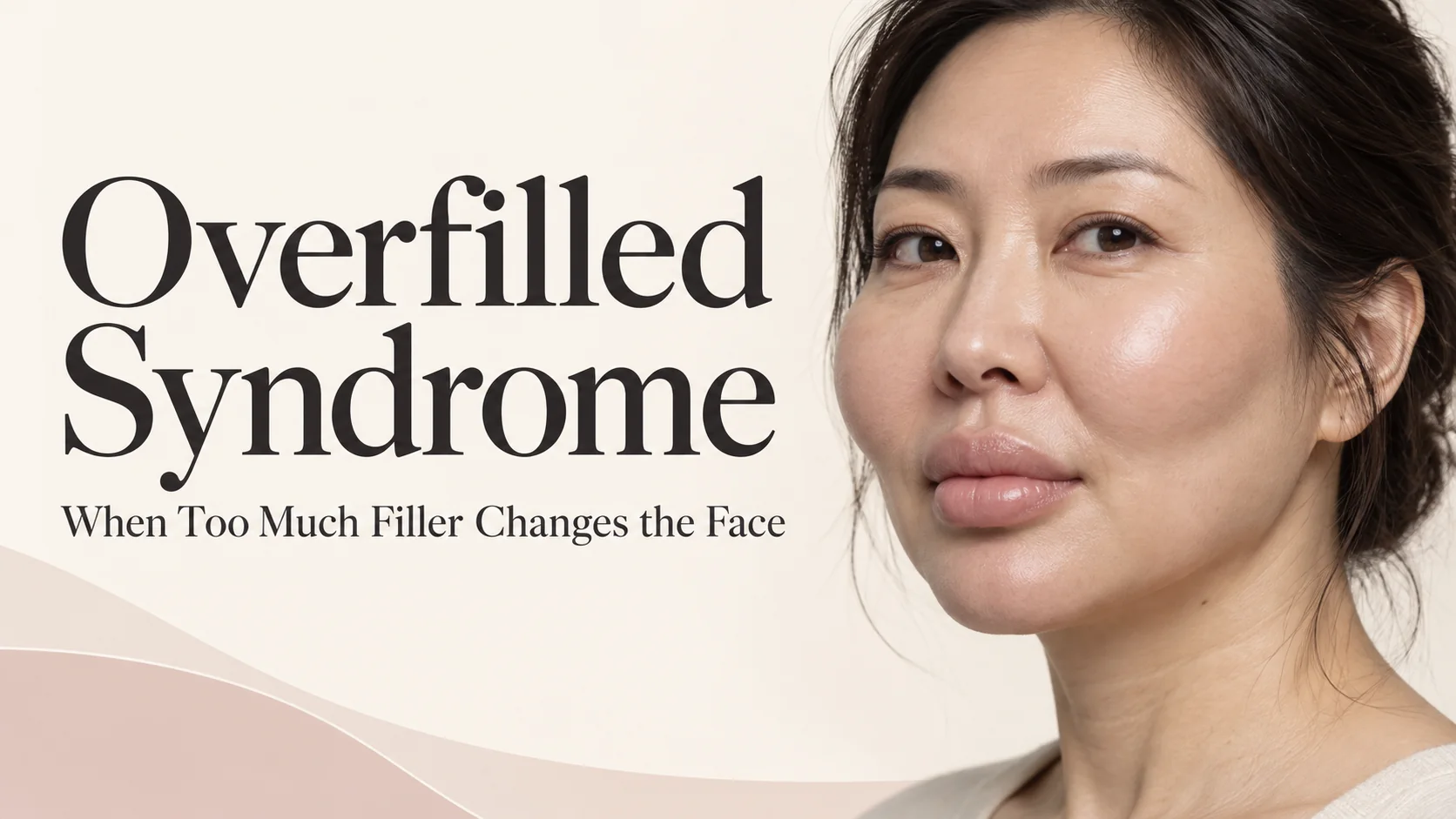
Afraid that filler will leave you with a puffy, heavy 馒化脸? Why a well-planned filler treatment does not cause an overfilled face, what really does, and how to get a refreshed look that still looks like you
Medically reviewed by Dr. Adriene Chee, Medical Director, Verve Clinic. Last updated: November 2026.
You have seen the photos: cheeks that look too full, a face that looks wider than it used to, a smile that no longer looks natural. Online, people call it “pillow face”. In Chinese, it is often described as 馒化脸, a face that has become puffy and round like a steamed bun. So when you finally think about filler for tired-looking cheeks or deep smile lines, one question comes first: will I end up looking like that?
It is a fair worry, and the honest answer is reassuring. In this guide, Dr. Adriene Chee, a doctor with more than 10 years of experience in injectables, explains what an overfilled face is, why a normal, well-planned filler treatment does not cause it, and what makes the difference between a refreshed face and an overfilled one.
What is an overfilled face (馒化脸)?
In short: An overfilled face (馒化脸), known medically as facial overfilled syndrome, is a puffy, heavy or unnatural look caused by too much filler, or filler in the wrong place. Any amount of filler will not cause it. It usually builds up over many sessions, from repeated top-ups, using filler to lift sagging skin, or choosing the wrong product. A well-planned treatment refreshes the face without overfilling it.
Doctors use the term facial overfilled syndrome for this problem. A 2026 clinical review describes it as a complication of filler treatment that causes an overly inflated look, changes in facial expression and unnatural fullness in the midface. The same review notes that it is becoming more common, and that it tends to be more noticeable in East Asian faces because of our bone structure and facial anatomy.
That rise is partly because filler is so popular. According to the International Society of Aesthetic Plastic Surgery, hyaluronic acid filler procedures increased by 5.2% to 6.3 million worldwide in 2024. When millions of people have filler, some of them will be overfilled. That does not mean filler itself is the problem.
Does any amount of dermal filler cause an overfilled face?
No. An overfilled face is not caused by having filler at all, or by a single well-planned treatment. It usually takes a large total amount of filler built up over time, often combined with the wrong product, the wrong placement or top-ups that were never needed. A small, correctly placed amount restores what time has taken without changing who you are.
There is also no single “safe” number of syringes that applies to everyone. How much is right depends on which areas are treated, how many sessions you have had before, how much of your previous filler is still there and the structure of your face. Two people can have the same amount of filler and look completely different. What matters is the plan behind it.
A note from Dr. Adriene Chee: “When patients ask me whether filler will make them look overfilled, I tell them that it takes a large amount of filler to get there, and that the product used, the area treated and the layer it is placed in are just as important. Well-planned filler should make you look rested and refreshed, not different.”
What does an overfilled face look like?
An overfilled face does not always look obviously “done”. Often, people simply sense that something is not quite right. These are the most common signs:
| Sign | What you may notice |
|---|---|
| Heavy, rounded cheeks | The cheeks look puffy or sit too far forward, sometimes described as “pillow face” |
| A wider midface | The face looks broader and flatter from the front, losing its natural contours |
| An unnatural smile | The face looks fine at rest, but the cheeks bunch up or look stiff when you smile |
| A bulging forehead | The forehead looks too round, shiny or lumpy instead of smooth and natural |
| Puffiness under the eyes | Swelling or bags that look worse in the morning, sometimes years after treatment |
| Loss of expression | The face looks similar whatever you are feeling, because natural movement is hidden |
What really causes overfilled syndrome?
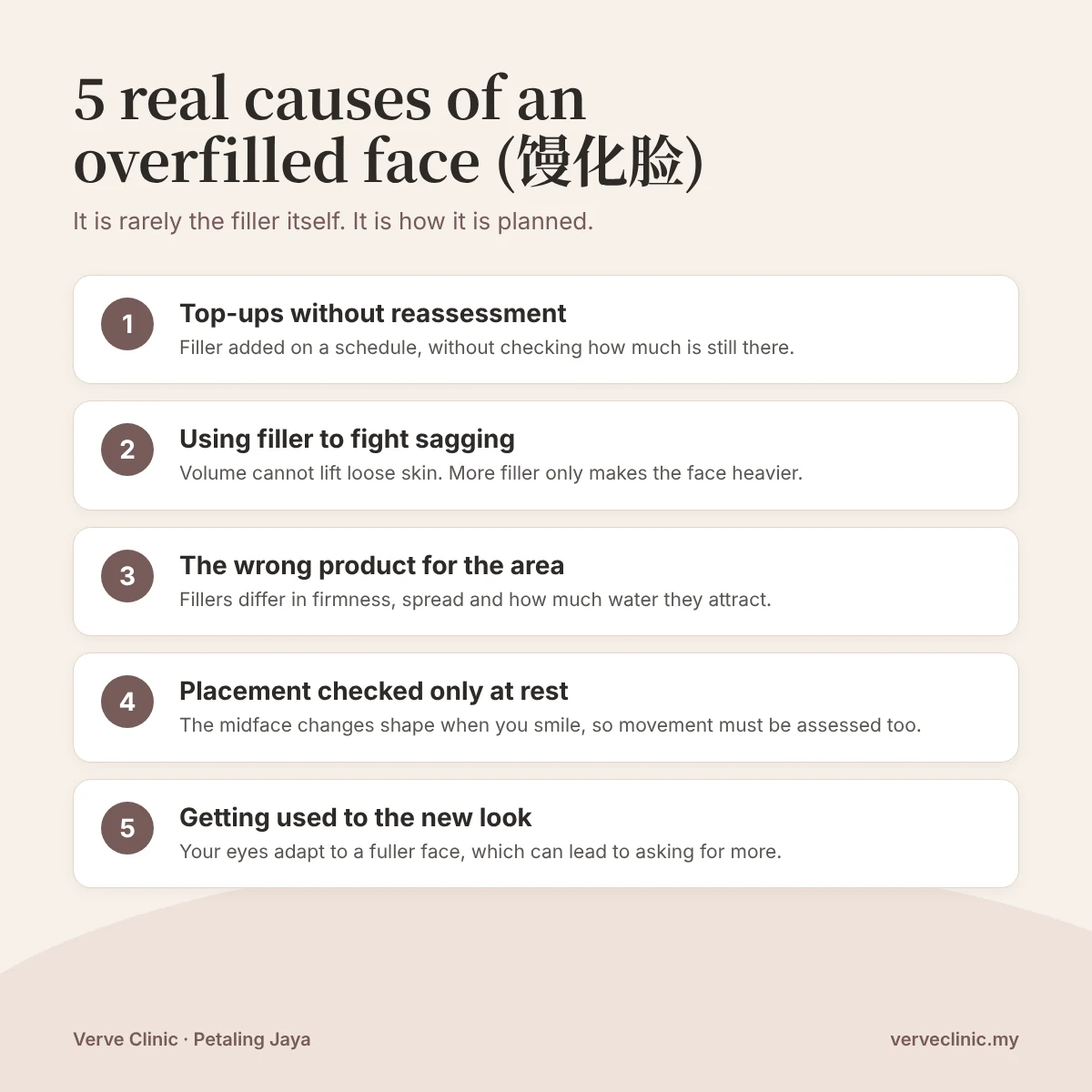
A 2025 review in the International Journal of Aesthetic Plastic Surgery describes overfilled face syndrome as a condition with several causes, not simply the result of too much volume. The causes come from the injector, the patient and the product. In practice, five causes stand out.
1. Top-ups without reassessment. Filler is often topped up on a schedule (“every 6 months”) rather than after checking how much is still there. Because some filler lasts longer than expected, each top-up adds to what remains, and the total slowly builds up into an overfilled face.
2. Using filler to fight sagging. As we age, the face loses volume, but it also sags. Filler replaces volume. It does not lift skin that has become loose. The 2026 review notes that injecting filler to counteract gravity and ageing is a key reason faces become overfilled. Treating sagging with more and more filler leads to a heavy, low-sitting, overfilled face.
3. The wrong product for the area. Hyaluronic acid fillers are not all the same. They differ in firmness, how much they spread, how much water they attract and how long they last. A filler that is ideal for the chin can look lumpy or puffy in the forehead or under the eyes, and add to an overfilled face. The 2025 review also names unregulated products and mixing different brands as risk factors.
4. Placement checked only at rest. Filler is usually injected while the face is still. The midface changes shape when we smile, so filler that looks perfect at rest can look bunched or unnatural in movement. A good assessment checks your face in expression, not only in the mirror at rest.
5. Getting used to the new look. When you see the same face every day, your eyes adjust to it. Researchers describe this as visual adaptation. Combined with filtered photos on social media, it can make a slightly full face look “normal” and lead to requests for more. An honest doctor will tell you when you do not need it.
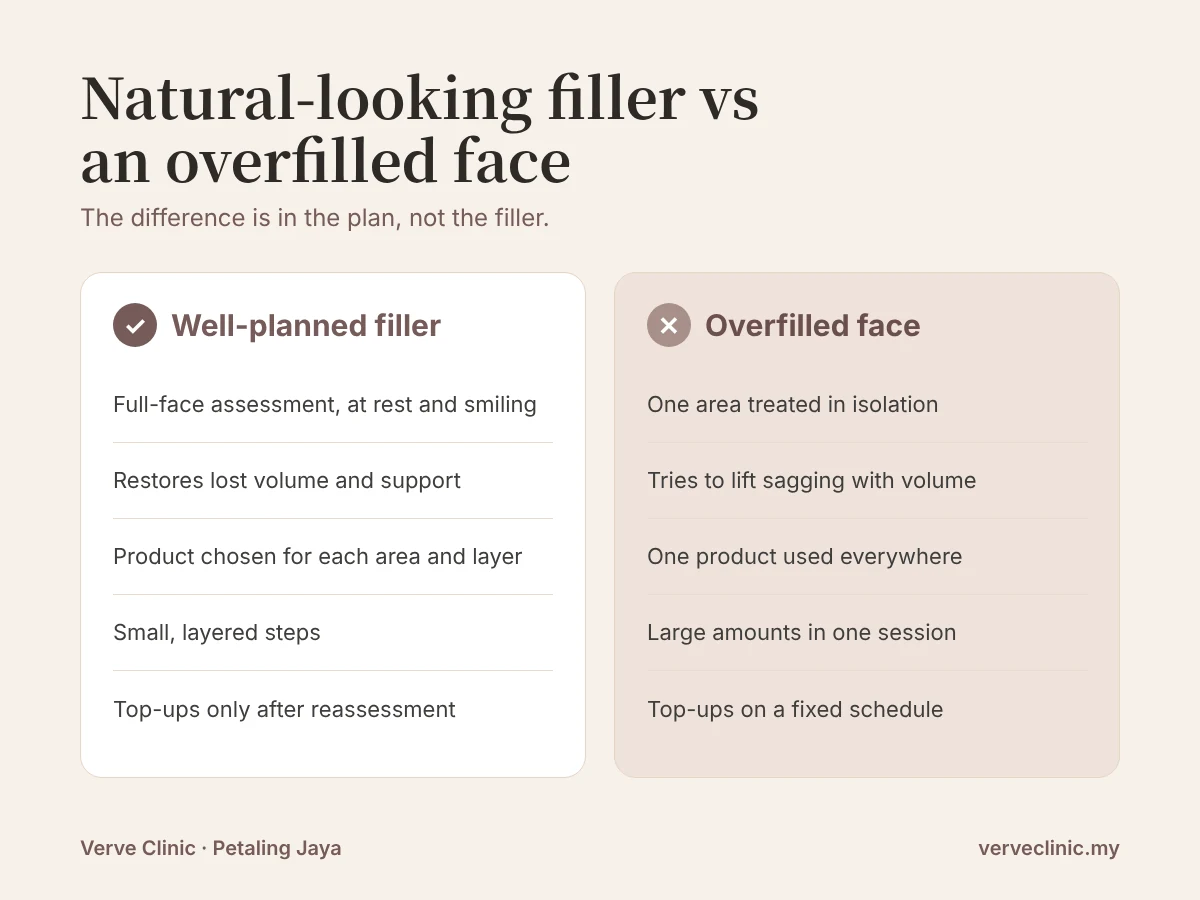
Natural-looking filler vs an overfilled face
The difference between a refreshed result and an overfilled face is rarely the filler itself. It is how the treatment is planned:
| Well-planned filler | Overfilled face | |
|---|---|---|
| Starting point | A full-face assessment, at rest and in expression | A single area treated in isolation |
| Goal | Restore lost volume and support | Lift sagging skin with volume alone |
| Product | Chosen for each area and depth | One product used everywhere |
| Amount | Small, layered steps, with room to add later | Large amounts in one session |
| Top-ups | Only after reassessing what remains | On a fixed schedule |
| Result | You look rested, and still like yourself | Puffy, wide or unnatural, especially when smiling |
How long does filler really stay in your face?
The visible effect of hyaluronic acid filler usually lasts 6 to 18 months, depending on the area. Tear troughs tend to last 6 to 9 months, while other areas can last longer. However, research shows that some filler can stay in the tissue longer than its visible effect.
- A case report in Plastic and Reconstructive Surgery Global Open followed one patient with MRI scans. Filler in the cheeks and midface was still visible at 27 months, while filler in the chin had almost completely broken down by 19 months. The filler had not moved from where it was placed.
- The 2026 review notes that ultrasound has detected filler more than 7 years after injection in some patients.
- In one well-known case, a UK beauty journalist had an MRI nearly four years after her last filler treatment, apart from one small lip top-up. It still showed filler in her cheeks, jawline, chin, under-eye area and lips, exactly where it had been injected.
This does not mean filler never breaks down. It means the amount left behind varies from person to person. The same review estimates that a key fat pad in the midface, just below the eye, holds only about 2 to 3 ml, and that only 0.02 to 0.06 ml of filler a year is needed to keep up with its natural loss. A full syringe placed there at every top-up can therefore add far more than that area is losing.
This is why we do not top up filler on a fixed schedule. We assess what is still there first, and add only what your face needs.
Why does the filler product matter so much?
Product choice is one of the most overlooked causes of an overfilled face. Each area of the face needs a filler with the right properties:
- Firmness: firmer fillers support bone-like areas such as the chin and jawline; softer ones suit areas that move, such as the lips
- Spread: some fillers stay in place, others blend smoothly into the tissue, which matters in thin-skinned areas like the forehead
- Water attraction: hyaluronic acid draws in water. A filler that swells too much in the wrong area can make the face look puffy over time
- How long it lasts: longer-lasting fillers are not always better, especially in areas that are topped up regularly
At Verve Clinic, we use genuine products registered with the Ministry of Health Malaysia, and you can see the box and batch number before treatment. We do not use unregistered fillers, and we choose the product for each area rather than using one filler everywhere. You can read more about how we use dermal fillers for different areas of the face.
Why are the cheeks, midface and forehead most at risk?
In our experience, the cheeks, midface and forehead are the areas where we see overfilling most often.
Cheeks and midface. These are often treated repeatedly in an attempt to lift the face. Because the midface is where the face moves most when we smile, extra filler here quickly creates an overfilled face that looks wide, heavy or stiff. Sagging in this area usually needs lifting, not more volume.
Forehead. A smooth, rounded forehead has become a popular trend, but the skin here is thin and sits directly over bone. Too much filler, or the wrong product, shows as a bulging or lumpy forehead. The forehead also needs careful technique, which is why it should only be treated by an experienced doctor.
Other areas, such as the lips and under-eyes, can also look overfilled, but the same principles apply: the right product, the right amount and the right placement.
How does Verve Clinic avoid an overfilled face?
Our approach is designed to give you a natural result, and to stop overfilling before it starts:
- Full-face assessment. We look at your whole face, at rest and in expression, and ask about every filler you have had before, including treatments elsewhere.
- Photos and facial mapping. We take photos and map the areas that need support, so the plan is based on your anatomy, not a fixed number of syringes.
- The right product for each area. We choose a filler suited to each area and depth, and show you the box and batch.
- Small, layered steps. We would rather add a little more at your review than put in too much on the first day.
- A review 2 weeks after treatment. Once swelling has settled, we check your result and adjust only if needed.
- Top-ups only after reassessment. We check what is still there before adding more, and we will tell you if you do not need it.
Should you use filler for sagging skin?
Usually not. Many patients who ask for more filler are really seeing sagging or loose skin, not volume loss. In these cases, adding filler makes the face heavier, while lifting and tightening treatments give a better result and reduce how much filler you need. These are the options we most often recommend:
| Treatment | What it does | Best for |
|---|---|---|
| AestheFill | Collagen biostimulator that helps your skin build its own collagen gradually | Hollows and laxity across the face, without a puffy look |
| Karisma | Collagen booster that improves firmness and skin quality | Mild laxity and facial contouring support |
| Juvelook | Collagen skin booster for skin quality | Thin, crepey or dull skin (not volume or lift) |
| Density RF | Radiofrequency that heats deep skin layers to tighten and lift | Loose skin on the full face, eyes and neck |
| HIFU | Focused ultrasound that lifts deeper support layers | Jowls, jawline and lower face, usually 3 sessions |
| Aptos thread lift | Dissolvable threads that lift and support the skin | Jowls, jawline and sagging cheeks |
| Matrix RF microneedling | Radiofrequency microneedling that tightens and smooths | Laxity, fine lines and skin texture |
Often, the most natural result comes from combining a small amount of filler with one of these treatments. If you are unsure which suits you, our guide to dermal fillers vs collagen biostimulators explains the difference.
Can an overfilled face be fixed?
Yes, in most cases. If the filler is hyaluronic acid, an overfilled face can be corrected by dissolving it with an enzyme called hyaluronidase. The 2026 review describes this as the established gold standard for overfilled syndrome. At Verve Clinic, we always keep hyaluronidase on hand.
The number of dissolving sessions depends on how much filler is present. After dissolving, we wait for the face to settle and then reassess. If some volume is genuinely needed, we can add a small amount back, usually about a week later, in the right place and with the right product. Often, patients need far less than they had before.
Not every filler can be dissolved. Collagen biostimulators and permanent fillers do not respond to hyaluronidase, which is another reason to know exactly what is being injected into your face.
Is filler right for me?
Filler may suit you if you:
- have hollow cheeks, temples or under-eyes from volume loss
- have deep smile lines or a weak chin or jawline
- want a refreshed look that still looks like you
- are willing to start with a conservative amount and build up gradually
Filler may not be the best first step if:
- your main concern is sagging or loose skin rather than hollowness
- you want a dramatic change in one session
- you have had a lot of filler elsewhere and are worried about an overfilled face, or unsure what is still there; in this case, we assess first and may suggest dissolving before adding more
- you are pregnant or breastfeeding, or have an active skin infection in the area
Dermal filler quick facts
| Quick facts | |
|---|---|
| Comfort | Numbing cream is used, and most fillers contain a local anaesthetic |
| Downtime | Minimal; most people return to normal activities the same day |
| Common side effects | Mild swelling, tenderness or bruising for a few days |
| When you see results | Immediately, with the final result after swelling settles |
| Review | 2 weeks after treatment |
| How long results last | Usually 6 to 18 months, depending on the area |
| Can it be reversed? | Yes, hyaluronic acid filler can be dissolved with hyaluronidase |
Frequently asked questions
Does any amount of filler cause an overfilled face?
No. An overfilled face usually comes from a large total amount of filler built up over many sessions, often with the wrong product or placement. A well-planned treatment, using the right product in the right place, refreshes the face without making it look overfilled.
What is 馒化脸?
馒化脸 is a Chinese term for a face that has become puffy and rounded, like a steamed bun (馒头), usually after too much filler. Doctors call it facial overfilled syndrome.
How much filler is too much?
There is no single safe number for everyone. It depends on the areas treated, how many sessions you have had, how long your previous filler has lasted and your facial structure. That is why each top-up should follow a fresh assessment, not a fixed schedule.
Can one syringe of filler make me look overfilled?
It is unlikely when the treatment is planned for your face and placed correctly. Problems usually start when filler is added repeatedly without checking how much is still there, or when it is used to lift sagging skin.
How long does hyaluronic acid filler last?
The visible effect usually lasts 6 to 18 months, depending on the area. Tear troughs tend to last 6 to 9 months. Imaging studies show some product can stay in the tissue for longer, which is why top-ups should be based on reassessment.
Which areas are most likely to look overfilled?
In our experience, the cheeks, midface and forehead. These areas are often treated repeatedly, and extra volume there quickly makes the face look wider, heavier or puffy.
Can an overfilled face be fixed?
Yes, if the filler is hyaluronic acid. It can be dissolved with an enzyme called hyaluronidase. The number of sessions depends on how much filler is present. Once the face has settled, your doctor reassesses and adds a small amount back only if it is needed.
Can all fillers be dissolved?
No. Only hyaluronic acid fillers can be dissolved with hyaluronidase. Collagen biostimulators and permanent fillers cannot, which is one reason product choice matters.
Will dissolving filler make my face sag?
Dissolving removes filler, not your own tissue. If the face looks flatter afterwards, it is usually because the filler was hiding volume loss or sagging. Your doctor can then treat that with a better-suited option.
What if my face is sagging rather than hollow?
More filler is not the answer for sagging. Collagen biostimulators, Density RF, HIFU, thread lifts and Matrix RF microneedling are better suited to lifting and tightening, and they reduce the amount of filler you need.
Is filler migration the same as an overfilled face?
No. Migration means filler has moved away from where it was placed, such as lip filler spreading above the lip line. An overfilled face means there is too much filler, even if it has stayed in place. Imaging studies show that well-placed filler usually stays where it was injected, which is why correct placement matters.
Is filler safe?
Hyaluronic acid filler has a good safety record when a trained doctor uses a genuine, registered product. Like any injection, it carries risks such as bruising, swelling and, rarely, blocked blood vessels, which is why your injector should be a doctor who keeps hyaluronidase on hand.
How do I avoid looking overfilled?
Choose a doctor who assesses your whole face, explains the product they use, treats in small steps, reviews you 2 weeks after treatment and is willing to say no to more filler when you do not need it.
How much does filler cost?
It depends on your treatment plan, so we give a personalised quote after your assessment. WhatsApp us for a quote.
Want a refreshed look without looking overfilled?
A natural filler result starts with an honest assessment. At Verve Clinic in Petaling Jaya, a doctor will assess your whole face, explain whether filler is the right choice and plan a treatment that keeps you looking like yourself. WhatsApp us to arrange your consultation.
About the author
Dr. Adriene Chee is the Medical Director of Verve Clinic in Petaling Jaya. She has more than 10 years of experience. Her qualifications include an MD from the National University of Malaysia (UKM), a Postgraduate Diploma in Dermatology (Bangkok) and an LCP in Aesthetic Medicine. Meet our team.
This article is general information, not medical advice. Results vary from person to person. Please discuss the benefits and risks of any treatment with a qualified doctor.